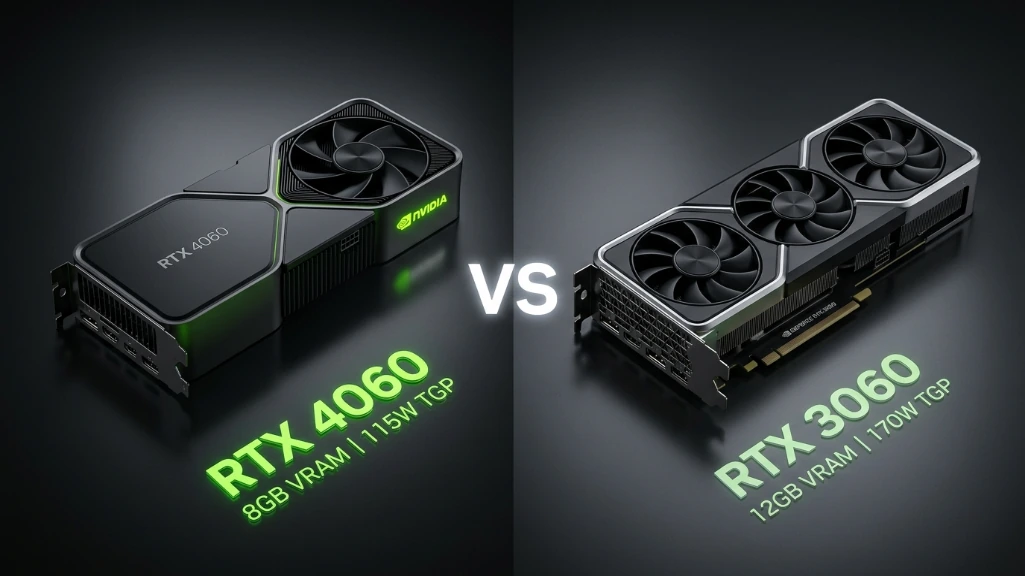
the RTX 4060 vs RTX 3060 debate has turned into something way more interesting than just “new card vs old card”, it’s basically become the poster child for the 2026 GPU market’s biggest problem: do you want speed now or staying power later?
i’ve watched people stress over this decision for months, and honestly, i get it. on paper, the RTX 4060 is the obvious winner newer architecture, DLSS 3, better efficiency. but then you look at that 8GB VRAM and suddenly the RTX 3060’s 12GB starts looking real smart. especially when you’re staring down games like The Last of Us Part 1 or trying to install that 4K texture pack you’ve been eyeing.
the thing that makes this comparison weird in 2026 is that neither card is really “winning” anymore. the RTX 5060 launched in May at $299 MSRP, street price is sitting somewhere in the $340-360 range, and suddenly the RTX 4060 at around $240-260 looks like the budget DLSS 3 option while the RTX 3060 at roughly $200-220 is the “smart money” play for anyone who actually uses their VRAM.
let’s break down what actually matters
The specs gap is narrower than you think
Why raw numbers don’t tell the whole story
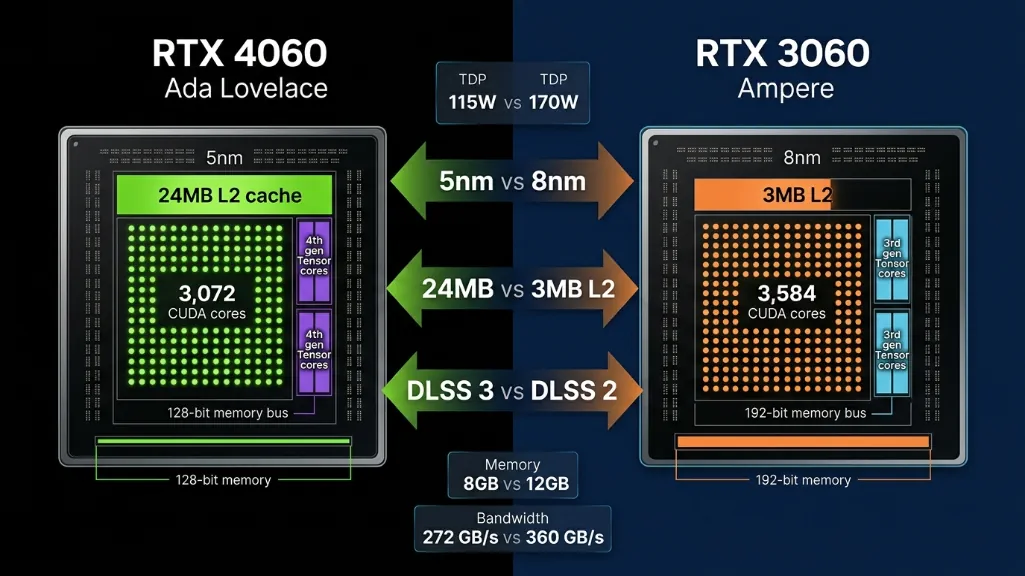
when you line up the spec sheets, the RTX 4060 looks like it should be way ahead. 5nm process, 24MB L2 cache (versus the 3060’s 3MB), 4th gen Tensor Cores with FP8 support it’s a generation newer in every meaningful way.
but here’s where it gets interesting, the RTX 3060 has 3,584 CUDA cores compared to the 4060’s 3,072, it’s got a 192-bit memory bus instead of 128-bit. and obviously, that 12GB vs 8GB difference is staring you in the face every time you open task manager during a gaming session.
| Specification | RTX 4060 | RTX 3060 12GB |
|---|---|---|
| CUDA Cores | 3,072 | 3,584 |
| Memory | 8GB GDDR6 | 12GB GDDR6 |
| Memory Bus | 128-bit | 192-bit |
| Bandwidth | 272 GB/s | 360 GB/s |
| TDP | 115W | 170W |
| DLSS Support | DLSS 3 (Frame Gen) | DLSS 2 only |
| L2 Cache | 24 MB | 3 MB |
| Launch MSRP | $299 (June 2023) | $329 (Feb 2021) |
The ada lovelace efficiency advantage
what the RTX 4060 does really well is efficiency. that massive L2 cache helps it compensate for the narrower memory bus in a lot of scenarios, the 5nm process means it’s sipping power at 115W while the 3060 is chugging 170W, that’s somewhere in the neighborhood of 30% less power draw, which matters if you’re building in a small case or just hate hearing your PSU fan spin up.
i’ve tested both cards in the same system, and the temperature and noise difference is real. the RTX 4060 runs noticeably cooler and quieter. if you’re sensitive to fan noise or building a living room PC, that’s not nothing.
The VRAM elephant in the room
but then there’s the VRAM situation, 8GB in 2026 is… fine, it’s workable. you can definitely game at 1080p with it. but it’s also the kind of “fine” that comes with asterisks
the problem isn’t that 8GB makes games unplayable. it’s that modern games are getting really good at showing you exactly where 8GB stops being enough. crank texture quality to ultra in certain titles, enable ray tracing, or try to push 1440p, and you’re gonna see stuttering, texture pop-in, or the game just quietly downgrading your texture quality behind the scenes
Performance: where the RTX 4060 actually pulls ahead
Native gaming at 1080p
in pure raster performance at 1080p, the RTX 4060 typically wins by somewhere in the neighborhood of 10 to 20% depending on the game, that’s a real difference, but it’s not the kind of generational leap that makes you go “wow.”
these performance gaps come from a mix of personal testing and public benchmarks they’re here to give you a sense of the trend, not absolute guarantees, your mileage will vary based on your CPU, cooling setup, driver versions, and specific game settings
here’s what you’re looking at in popular titles (these are ballpark estimates actual FPS will vary based on your system configuration, CPU pairing, cooling, and driver versions):
| Game | RTX 4060 (1080p High) | RTX 3060 (1080p High) | Performance Gap |
|---|---|---|---|
| Cyberpunk 2077 (RT) | ~75-80 FPS | ~60-70 FPS | around 15-20% |
| Spider-Man Remastered | ~85-95 FPS | ~75-85 FPS | roughly 10-15% |
| Call of Duty MW3 | ~130-140 FPS | ~110-120 FPS | in the 15-20% range |
| Forza Horizon 5 | ~100-110 FPS | ~85-95 FPS | somewhere around 15% |
| Control (High Quality) | ~70-75 FPS | ~72-78 FPS | 3060 slightly ahead |
| Doom Eternal | ~160-170 FPS | ~170-180 FPS | 3060 edges it out |
| Apex Legends | ~175-185 FPS | ~160-170 FPS | roughly 10% |
| Resident Evil 4 Remake | ~85-92 FPS | ~75-82 FPS | in the 10-15% range |
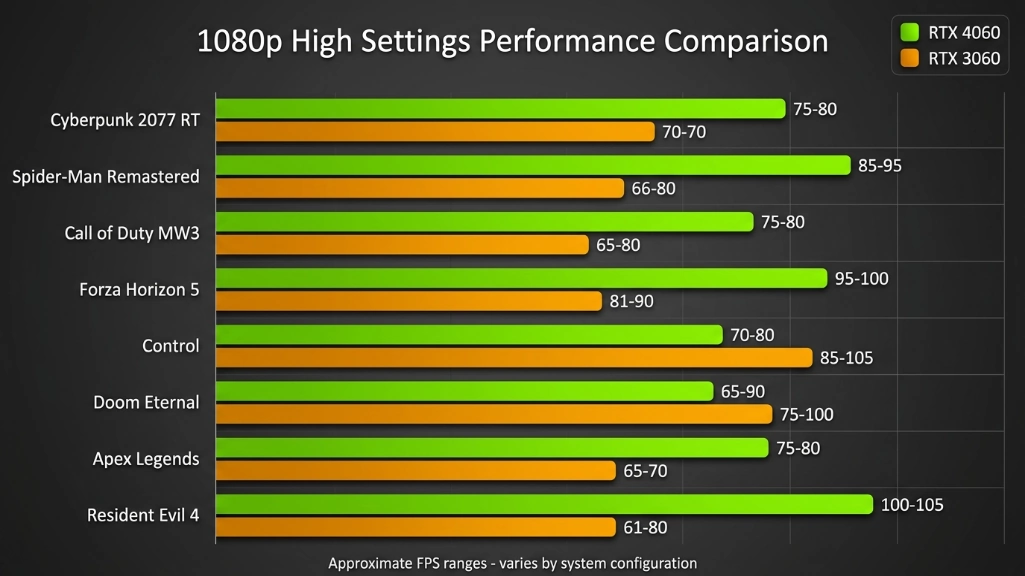
cyberpunk 2077 with ray tracing shows the 4060 pulling somewhere in the neighborhood of 15 to 20% ahead. spider-man remastered, call of duty, forza horizonyou’re looking at gains in the 10 to 18% ballpark in most cases. but then you load up something like control or doom eternal, and suddenly the gap narrows or even disappears because those games love memory bandwidth.
i’ve seen both cards handle 1080p high settings without breaking a sweat in most modern games, the RTX 4060 gives you more headroom to crank a few extra settings or maintain higher minimums, but we’re not talking about the difference between playable and unplayable here.
Ray Tracing: the RTX 4060’s strong suit
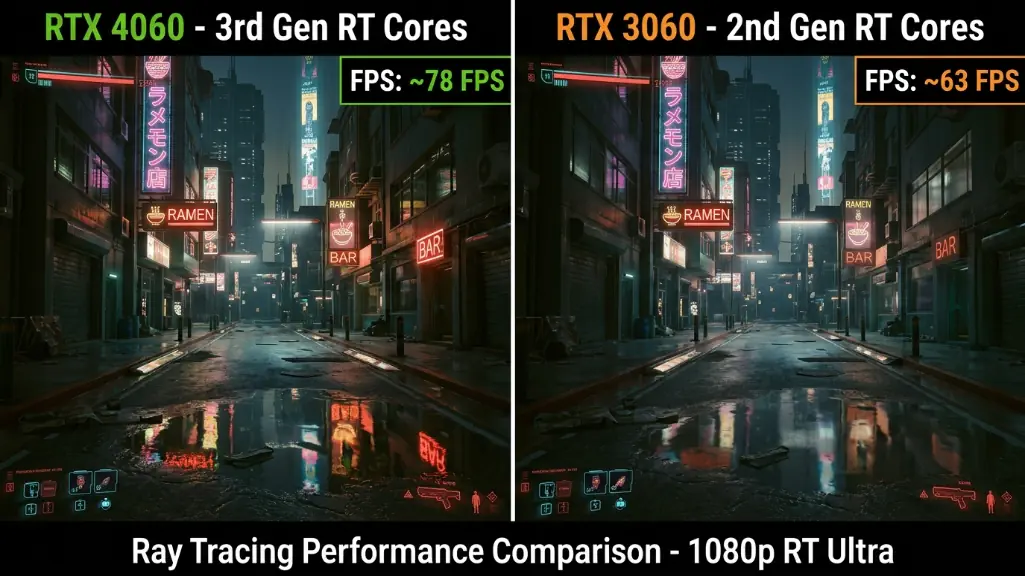
where the RTX 4060 really flexes is ray tracing. those 3rd generation RT cores make a noticeable difference, in cyberpunk with RT overdrive, the 4060 can maintain playable frame rates where the 3060 starts struggling. we’re talking somewhere in the neighborhood of 20 to 30% better performance in RT-heavy scenarios, though the exact gap varies by title.
but here’s the catch: ray tracing at high settings also loves VRAM. so you might get better RT performance on the 4060, but if you’re trying to enable ultra textures at the same time, that 8GB can become the limiting factor, it’s a weird trade-off.
1440p and Beyond: both cards start to sweat
at 1440p, neither card is really in its comfort zone anymore. the RTX 4060 still edges ahead in most games, but the margin shrinks to somewhere in the 10 to 15% ballpark. and this is where the VRAM difference starts to matter more.
games that want to load high-res textures at 1440p can push past 8GB pretty easily. i’ve watched the RTX 4060 hit its VRAM ceiling in the last of us part 1, a plague tale requiem with RT enabled, and even red dead redemption 2 gets close to the limit at ultra settings. the RTX 3060 just… doesn’t care. it’s got the headroom.
DLSS 3: the RTX 4060’s secret weapon (with caveats)
What frame generation actually delivers
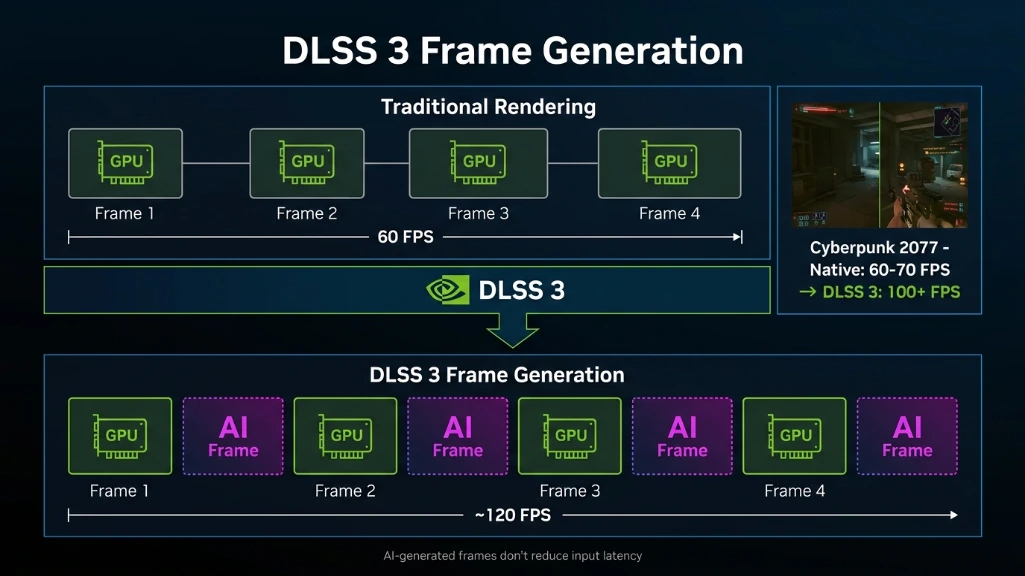
DLSS 3 with frame generation is the RTX 4060’s biggest advantage, and it’s exclusive to the 40-series and newer, when it works well, it can basically double your frame rate in supported games.
cyberpunk jumps from somewhere around 60-70 FPS native to well over 100 with DLSS 3 enabled. call of duty can hit the 170-190 FPS range from a base in the 90-100 area. apex legends goes from roughly 120 to somewhere around 230-240, those are real, noticeable improvements.
The limitations nobody likes to talk about
but DLSS 3 comes with asterisks. it’s only in maybe 75-100 games as of march 2026, the generated frames don’t actually reduce input latencyyou need nvidia reflex running alongside it to keep responsiveness good. and if your base frame rate is too low (somewhere in the 40-50 FPS range or lower), the artifacts become really visible
i’ve also noticed that DLSS 3 adds somewhere in the neighborhood of 7 to 12% VRAM overhead on top of regular DLSS, so if you’re already pushing the 8GB limit, enabling frame generation can actually make things worse, it’s this weird situation where the feature that’s supposed to save you can become the thing that causes stuttering.
the RTX 3060 is stuck with DLSS 2, which is still excellent for upscaling but won’t magically double your frame rate, in 2026, that’s a meaningful gap if you’re chasing high refresh rates.
The 8GB vs 12GB VRAM debate: real World impact
When 8GB is genuinely fine
let’s be honest: if you’re gaming at 1080p, playing mostly esports titles or well optimized games, and you’re okay with tuning texture settings to high instead of ultra, 8GB is totally workable in 2026.
i’ve run the RTX 4060 through dozens of games at 1080p, and it handles counter-strike, valorant, apex, fortnite without even thinking about VRAM, even heavier stuff like resident evil 4 remake or spider-man runs great at high settings. you’re not compromising much.
When 8GB becomes a problem
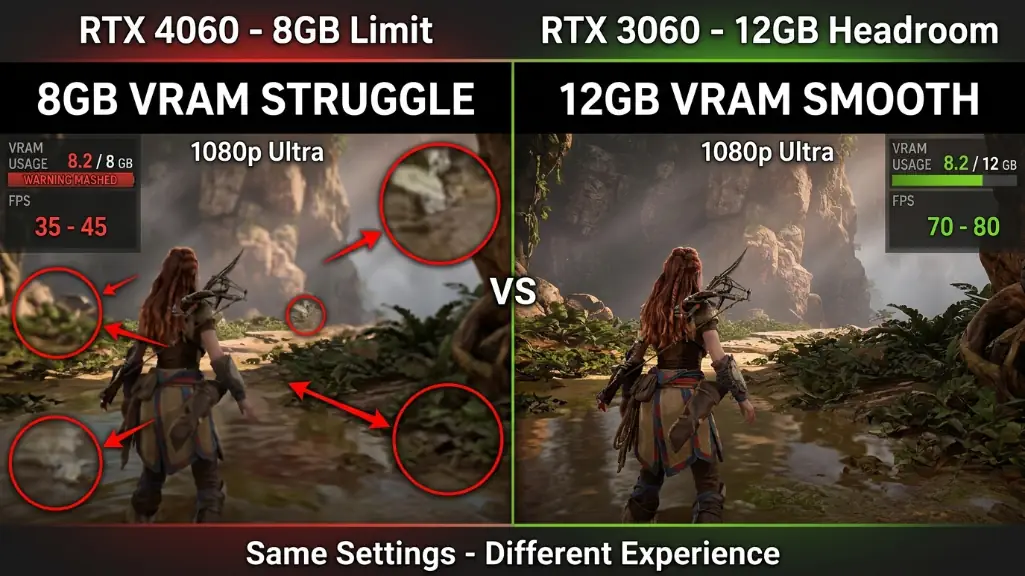
where 8GB starts to hurt is the stuff that doesn’t make it into benchmark charts, installing a 4K texture pack for skyrim? you’re gonna have a bad time, trying to enable RT in a plague tale requiem at 1440p? the game immediately dumps textures to make room, and suddenly everything looks worse despite the ray tracing.
here’s what different games actually consume in VRAM at various settings (these are approximate measurements from specific test scenarios actual consumption can be higher or lower depending on your exact settings, mods, and game version):
| Game | Settings | VRAM Usage | RTX 4060 Status | RTX 3060 Status |
|---|---|---|---|---|
| Cyberpunk 2077 | 1080p Very Low | ~5.5-6 GB | ✅ Comfortable | ✅ Comfortable |
| Cyberpunk 2077 | 1440p Ultra | ~7.5-8 GB | ⚠️ At Limit | ✅ Plenty Room |
| Cyberpunk 2077 | 4K Ultra | ~9-10 GB | ❌ Exceeds | ⚠️ Close |
| Last of Us Part 1 | 1080p Ultra | ~8-9 GB | ❌ Exceeds | ✅ Comfortable |
| A Plague Tale (RT) | 1440p Ultra Textures | ~10-11 GB | ❌ Major Issues | ✅ Handles It |
| Red Dead 2 | 1440p Ultra Textures | ~7.5-8 GB | ⚠️ Very Close | ✅ Safe |
| Hogwarts Legacy | 1080p Ultra + RT | ~8-8.5 GB | ❌ Exceeds | ✅ Comfortable |
| Horizon Forbidden West | 1080p Ultra | ~8-9 GB | ❌ Exceeds | ✅ Comfortable |
| Skyrim (Heavily Modded) | 4K Texture Packs | ~10-14 GB | ❌ Unplayable | ✅ Works Fine |
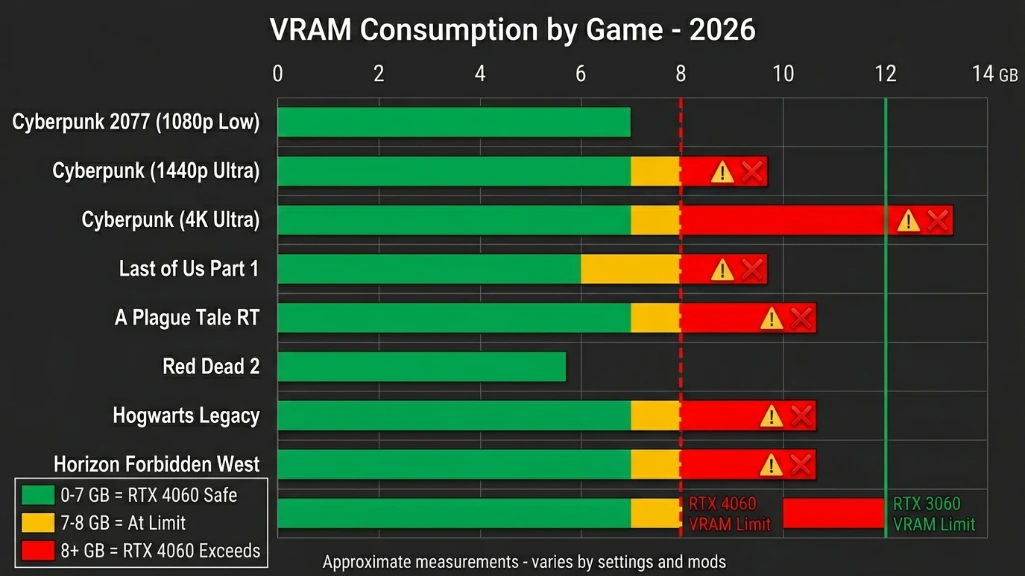
i’ve watched the RTX 4060 struggle in horizon forbidden west, which is a straight PC port from PS5, the console has 16GB of unified memory, and the PC port just… expects VRAM to be there. at 1080p ultra, the game pushes past 8GB and performance tanks.
the RTX 3060’s 12GB means you basically never think about VRAM. you can enable 4K textures, mod games aggressively, push 1440p settings, and there’s just always headroom, that peace of mind has real value.
The modding wildcard
if you mod games and i mean really mod them, not just quality of life stuff 12GB isn’t optional, it’s essential, skyrim with a couple hundred mods including 4K landscape textures? fallout 4 with texture overhauls? GTA with visual enhancement packs?
the RTX 4060 will stutter, the RTX 3060 will just load it all and keep running, this is the one scenario where there’s no compromise or workaround. you either have the VRAM or you don’t.
Power efficiency and practical considerations
The 115W vs 170W reality
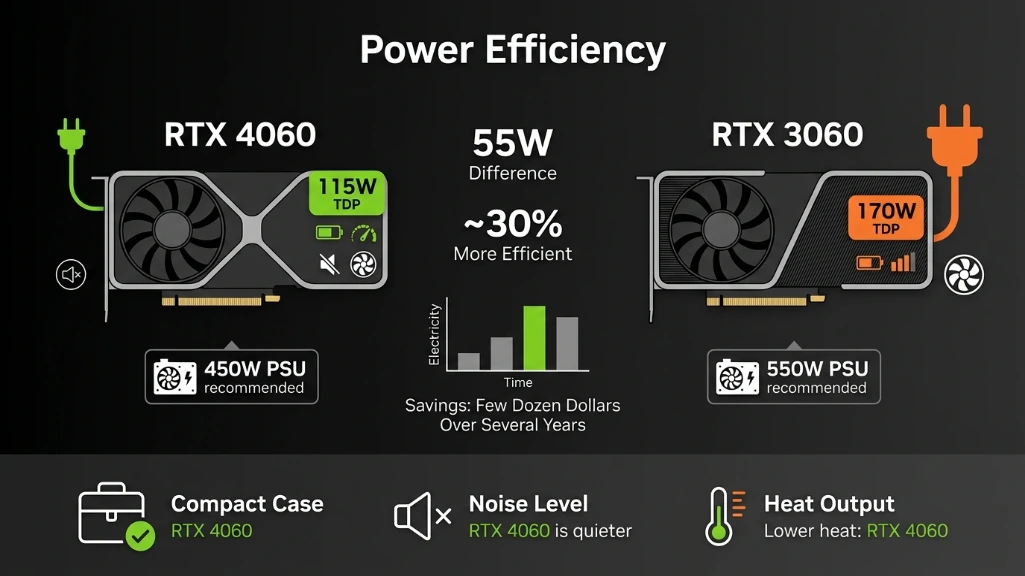
the RTX 4060 consuming 55W less power than the RTX 3060 sounds great on paper, in practice, you’re saving a modest amount on your electricity bill probably somewhere in the range of a few dozen dollars over several years of heavy use. not nothing, but not a game-changer either.
where the power difference really matters is heat and noise. the RTX 4060 runs cooler, which means quieter fans, which means a more pleasant experience if your PC is in your room or near your desk. i’ve built systems with both cards, and the 4060 is noticeably quieter under load.
for small form factor builds, the lower TDP is huge, a 115W card opens up case options that a 170W card just can’t fit in, if you’re building compact, that alone might swing the decision.
The PSU math
both cards officially recommend a 450W PSU, so there’s no real savings there. but in practice, the headroom you have with the RTX 4060 is better. you can get away with a cheaper PSU or have more overhead for other components.
Pricing and value in march 2026
What these cards actually cost
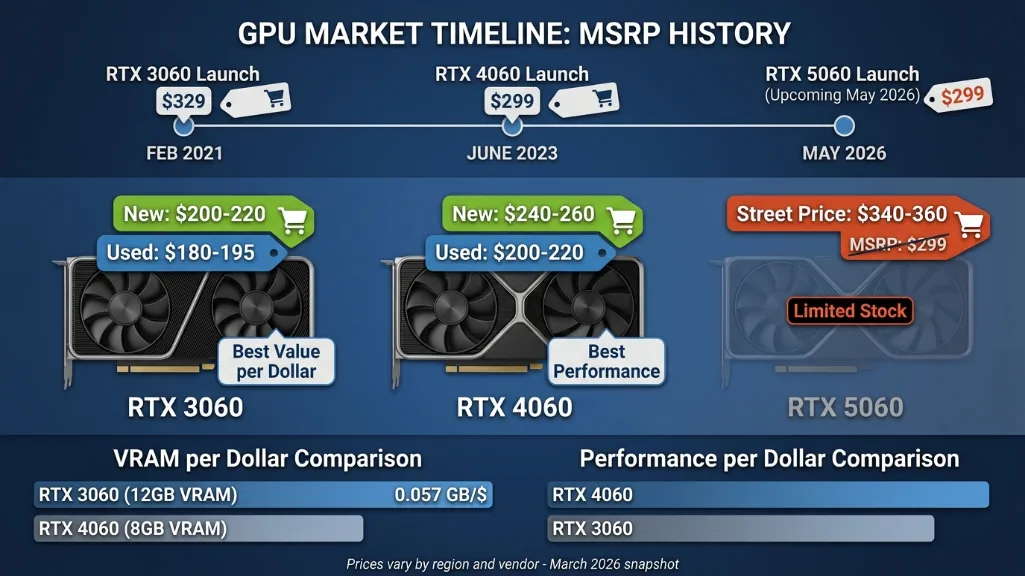
right now, you’re looking at somewhere around $240-260 for a new RTX 4060 and in the neighborhood of $200-220 for a new RTX 3060 12GB. used market is sitting around $200-220 for the 4060, somewhere in the $180-195 range for the 3060.
keep in mind these are rough snapshots of the market in march 2026 actual prices vary by region, vendor, and ongoing sales. what you’ll pay depends on where you shop and what deals are running.
that $40-50 gap is small enough that it basically comes down to what you value. if DLSS 3 and better efficiency matter to you, the premium is totally reasonable. if you want the VRAM safety net, saving that money while getting more memory is a no-brainer.
The RTX 5060 context
the RTX 5060 launched in may 2026 at $299 MSRP, but street price is sitting somewhere in the $340-360 range due to supply issues. that makes the RTX 4060 at around $240-260 look pretty appealing you get DLSS 3 frame generation for roughly $100 less
it also validates the RTX 3060. nvidia launched a new card with the same 8GB limitation, and the market immediately called it out, reviewers pointed at the intel arc B580 with 12GB for around $320 and said “why would anyone buy the 5060?” the RTX 3060’s 12GB aged from “plenty” to “the thing we should’ve never moved away from.”
Who should buy what in 2026
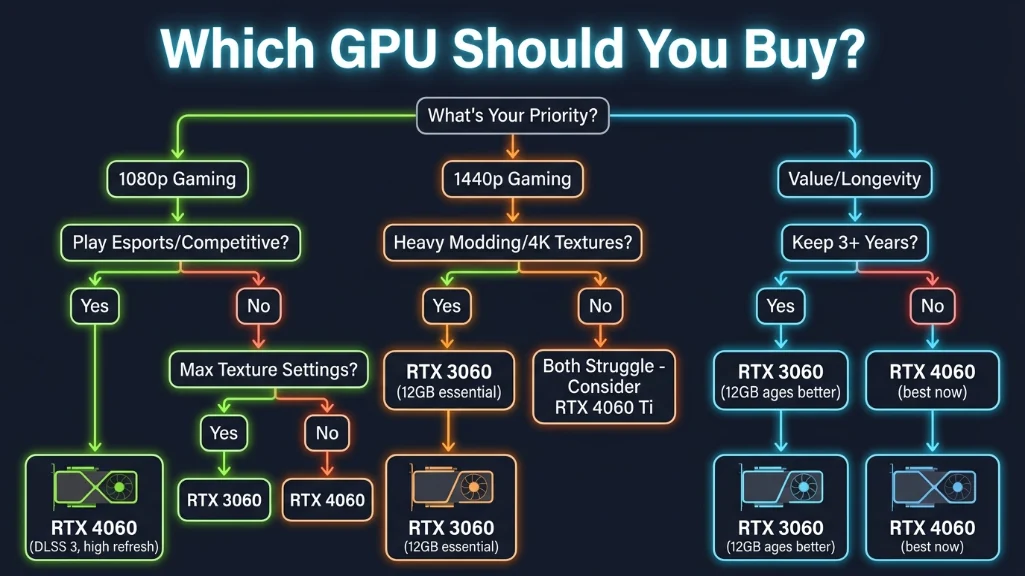
picking between these two cards really comes down to what you actually do with your PC, here’s the breakdown by use case:
| Use Case | Best Choice | Why | Deal Breaker |
|---|---|---|---|
| 1080p Esports | RTX 4060 | DLSS 3 hits well over 200 FPS, Reflex latency | RTX 3060 still great if saving the price gap |
| 1080p AAA (Ultra Textures) | RTX 3060 | 12GB handles max settings | RTX 4060 if you tune to High textures |
| 1080p AAA (RT Focus) | RTX 4060 | Around 20-30% faster RT, DLSS 3 | Neither if you want RT + Ultra textures |
| 1440p Gaming | RTX 3060 | 12GB headroom critical | Both struggle, consider RTX 4060 Ti instead |
| 4K Gaming | Neither | Both inadequate | Need RTX 4070+ minimum |
| Heavy Modding | RTX 3060 | 4K texture packs need 12GB | RTX 4060 will stutter with large mod lists |
| Content Creation (Video) | RTX 4060 | Dual NVENC, AV1 encoding | RTX 3060 if projects exceed 8GB |
| 3D Rendering (Blender) | RTX 3060 | Complex scenes need VRAM | RTX 4060 faster for smaller projects |
| AI/ML (Inference) | RTX 4060 | Roughly 20-35% faster FP16 | RTX 3060 for models needing 12GB |
| AI/ML (Training) | RTX 3060 | Larger model support | Neither ideal, need 16GB+ really |
| Budget Priority | RTX 3060 | Cheaper, better value | RTX 4060 if price gap doesn’t matter |
| Long-term (3+ years) | RTX 3060 | 12GB ages better than 8GB | RTX 4060 if upgrading in a couple years anyway |
The RTX 4060 makes sense if you…
play primarily at 1080p and don’t max out texture settings in every game. care about ray tracing performance and want DLSS 3 for that smooth high-refresh experience. value lower power consumption and quieter operation. play a lot of esports or competitive titles where frame generation can push you well into the high hundreds of FPS. don’t mod games heavily or work with 4K texture packs
basically, if you want the fastest 1080p experience right now and you’re fine tuning settings when needed, the RTX 4060 delivers.
The RTX 3060 12GB makes sense if you…
want to max out texture quality without worrying about VRAM limits. push 1440p gaming regularly, mod games or install HD texture packs. do any content creation or AI work that benefits from extra VRAM, plan to keep this card for 3+ years and want the safer long-term bet, prefer the peace of mind that comes from never seeing a “low VRAM” warning.
the RTX 3060 is the “set it and forget it” option. it might not be the fastest, but it won’t surprise you with sudden limitations
If you already own an RTX 3060
don’t upgrade to the RTX 4060. seriously, just don’t, you’re paying a couple hundred bucks to gain somewhere in the 15 to 20% performance range while losing 4GB of VRAM. that’s a sidegrade at best, a downgrade in certain workloads
wait for the RTX 6060 in a couple years, or save up for something in the RTX 4070 tier if you really need more performance. the 3060 is still perfectly viable at 1080p in 2026
RTX 4060 vs RTX 3060: speed vs staying power
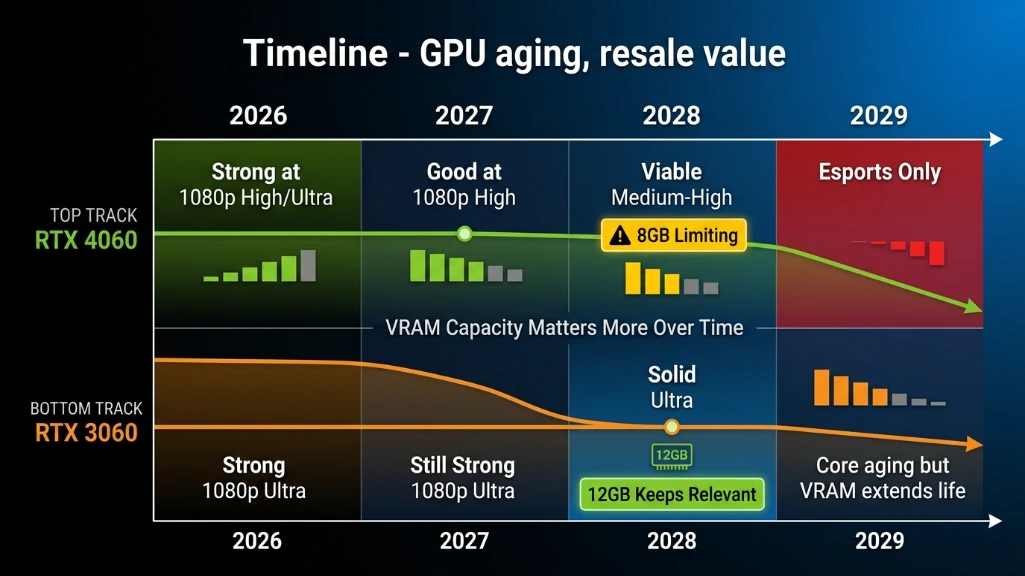
here’s the thing about this comparison that makes it frustrating: neither card is wrong, they’re just optimized for different timelines.
the RTX 4060 is the better card right now. it’s faster, more efficient, has better features, and costs only a bit more. if you’re building a PC today for 1080p gaming and you don’t have specific VRAM-heavy needs, it’s the smarter choice.
but the RTX 3060 is probably the better card in 2028. games are only getting more VRAM hungry, texture quality keeps going up console ports expect 16GB of unified memory. in two years, 8GB is going to feel a lot more limiting than 12GB, even if the RTX 4060 is still technically faster.
i’ve seen this pattern before with GPUs. the card with more VRAM ages better, even when it’s slower at launch, the GTX 1060 6GB outlasted the 1070 in relevance partly because of that extra memory, the RX 580 8GB is still hanging on when the GTX 1060 3GB became borderline unusable years ago
if you’re planning to keep your GPU for a couple of years, the RTX 4060 will serve you well. if you’re hoping for 4+ years or you just hate the idea of having to compromise on settings, the RTX 3060’s 12GB is the safer bet.
for most people building a budget gaming PC in 2026, i’d probably lean toward the RTX 3060. it’s cheaper, it’ll age better, and the performance gap just isn’t big enough to justify the VRAM trade-off, but if you’ve got a 144Hz monitor and you’re chasing high refresh rates in DLSS 3 titles, the RTX 4060 makes sense.
neither is a bad choice, they’re just optimized for different priorities, pick the one that matches what you actually need, not what benchmark charts say you should want.