
Most 4K build guides bury the lead, here it is: the GPU does almost everything at this resolution, a Ryzen 5 7600 and a Ryzen 7 9800X3D land close enough in most 4K benchmarks that the CPU choice barely shows up in the results, as long as the GPU is the one doing the heavy lifting, one real decision, which GPU you’re willing to pay for. This 4k gaming pc build guide breaks down that GPU decision, since it’s the only choice that actually matters at this resolution.
In June 2026, that decision is expensive no matter which direction you go, most cards are above MSRP, GPU supply is still squeezed, the RTX 5090 costs $3,500+ on the open market. Here’s what actually makes sense.
The GPU decision
Tom’s Hardware’s GPU Hierarchy puts the RX 9070 XT as the value pick at 4K, 60 FPS average across their rasterization suite at 4K ultra, the RTX 5070 Ti lands nearby on native performance but brings DLSS 4 and Multi Frame Generation, past those two, you’re deep into diminishing returns territory.
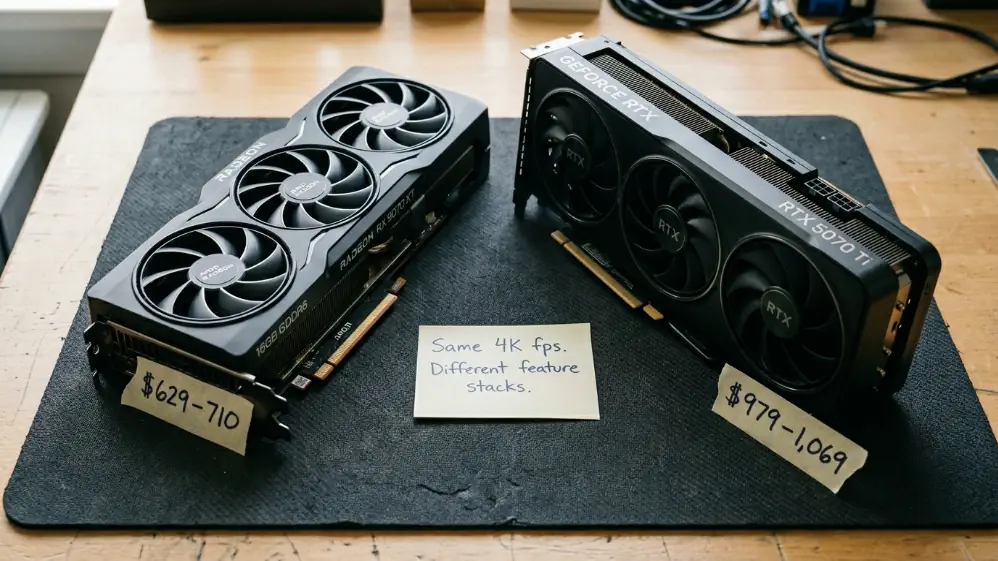
RX 9070 XT (~$629–710): The value case
Sixty FPS average at 4K ultra per Tom’s Hardware, 16GB GDDR6 that doesn’t run dry at this resolution, FSR 4 when you want extra headroom, prices have drifted well past the $599 MSRP, $629–710 is the realistic range in June 2026, with occasional deals below that.
The ceiling is real though, some demanding titles at max settings flirt with that 60 FPS average, and DLSS 4 Multi Frame Generation, the feature that genuinely multiplies frame rates, isn’t on the AMD side. If that’s what you’re after, you need NVIDIA.
RTX 5070 Ti (~$979–1,069): The DLSS 4 argument
At $749 MSRP this was an easy recommendation, at $979–1,069 street price it’s harder to love, but it’s still the most sensible NVIDIA option at 4K.
Tom’s Hardware called it “the last card with a reasonable price-to-performance ratio before things get crazy,” GamersNexus put it at 107 FPS native in Final Fantasy XIV at 4K, but the native number isn’t the point, what MFG does on top of it is, in compatible single-player games, MFG can push effective frame rates well beyond what the GPU renders natively, the gap is big enough to feel like a genuinely different machine.
RTX 5080 (~$1,249): Hard to justify
The 5080 pulls ahead of the 5070 Ti by 12–16% at 4K and leaves the RX 9070 XT behind by 25–30% (GamersNexus), that’s not nothing, But at $1,249 versus the 5070 Ti’s $979–1,069 street price, you’re paying 17–28% more for those gains. Find one at $999 MSRP and the equation looks better, at going rates though, the 5070 Ti is the easier call for most budgets.
RTX 5090 (~$3,500+): Different conversation
Thirty to 68.9% faster than the 5080 at 4K depending on what you’re running (GamersNexus). If money genuinely isn’t the constraint, it’s the obvious answer. For most people building a serious 4K rig, the 5070 Ti or 5080 is where it ends.
The two 4k gaming PC build options
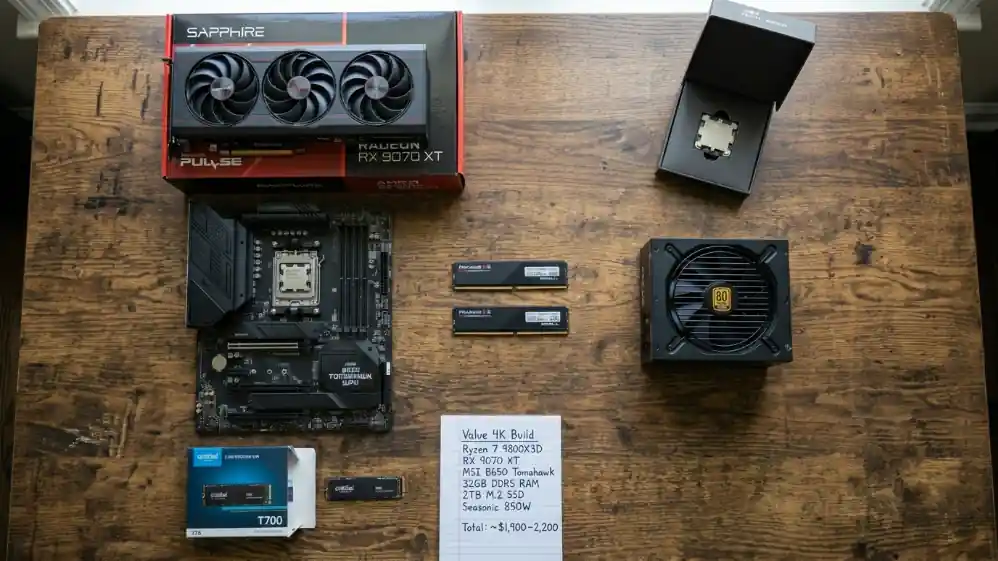
Value 4K build: RX 9070 XT
| Component | Pick | Price (June 2026) |
|---|---|---|
| GPU | RX 9070 XT 16GB | ~$629–710 |
| CPU | Ryzen 7 9800X3D | ~$438–440 |
| Motherboard | MSI MAG B650 Tomahawk WiFi | ~$180–220 |
| RAM | 32GB DDR5-6000 CL30 | ~$285–450 |
| Storage | 2TB NVMe PCIe Gen4 | ~$100 |
| CPU Cooler | 240mm AIO | ~$60–80 |
| PSU | 850W 80+ Gold | ~$85–100 |
| Case | Mid-tower ATX | ~$80–100 |
| Total | ~$1,857–2,200 |
Premium 4K build: RTX 5070 Ti
| Component | Pick | Price (June 2026) |
|---|---|---|
| GPU | RTX 5070 Ti 16GB GDDR7 | ~$979–1,069 |
| CPU | Ryzen 7 9800X3D | ~$438–440 |
| Motherboard | MSI MAG X670E Tomahawk WiFi | ~$240–260 |
| RAM | 32GB DDR5-6000 CL30 | ~$285–450 |
| Storage | 2TB NVMe PCIe Gen4 | ~$100 |
| CPU Cooler | 240mm AIO | ~$60–80 |
| PSU | 850W 80+ Gold | ~$85–100 |
| Case | Mid-tower ATX | ~$80–100 |
| Total | ~$2,267–2,599 |
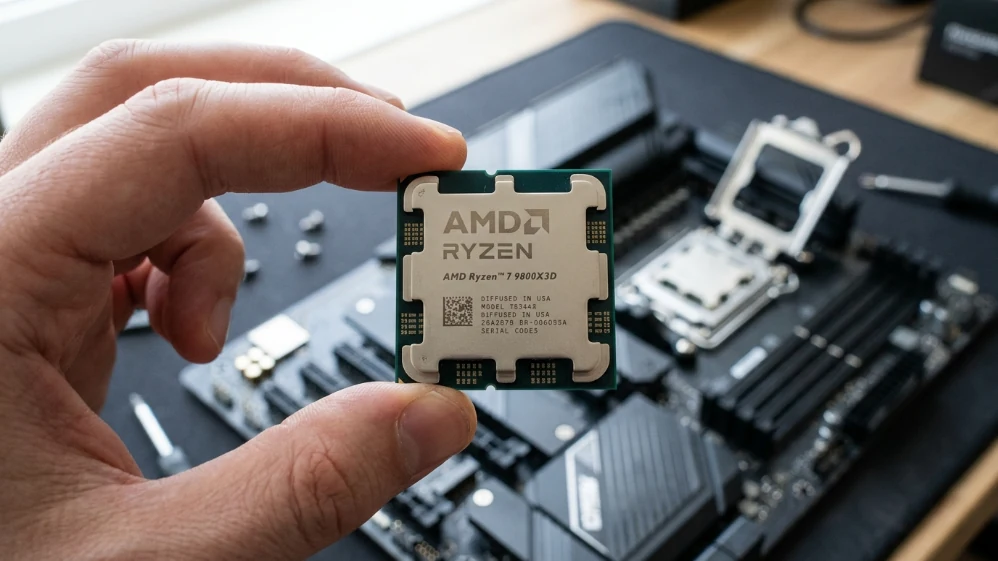
Why the 9800X3D even at 4K
At 4K the CPU barely shows up in benchmarks, a budget chip would do fine in a straight-up GPU benchmark, the problem is you don’t only play at 4K, drop into a competitive title or a game that runs poorly at native 4K, and the CPU becomes the whole story, fast, the 9800X3D makes that a non-issue at any resolution, and when the GPU costs over a grand, saving $200 on the processor is the wrong trade.
AM5 is also good through at least 2027, so there’s a real upgrade path when you want one.
RAM and storage
DDR5-6000 CL30 is the target for any AM5 build, it’s where AMD platforms actually wake up, enable EXPO in BIOS after installing the sticks or they’ll run at slower default speeds, RAM pricing in June 2026 is tighter than it should be, the cheapest reliable 32GB kit (Team T-Create Classic) starts around $285, while name-brand options from Corsair and G.Skill run $420–450 or more, AI-related DRAM demand has compressed supply and prices are volatile, worth checking on the actual day you order, because this line moves more than any other component in the build.
Storage is simpler, two terabytes of NVMe Gen4 covers everything, Gen5 drives cost more and don’t change anything about how games load or run.
PSU
An 850W unit covers the RX 9070 XT (304W TDP) and RTX 5070 Ti comfortably when paired with the 9800X3D, the RTX 5080 at 360W TDP also needs 850W, NVIDIA’s official 750W recommendation doesn’t leave enough room for power spikes under real gaming load. RTX 5090 build? Start at 1000W. Whatever you pick, stay with known names: Corsair, Seasonic, be-quiet!, a cheap PSU is the one failure that can take everything else with it.
The monitor thing nobody mentions
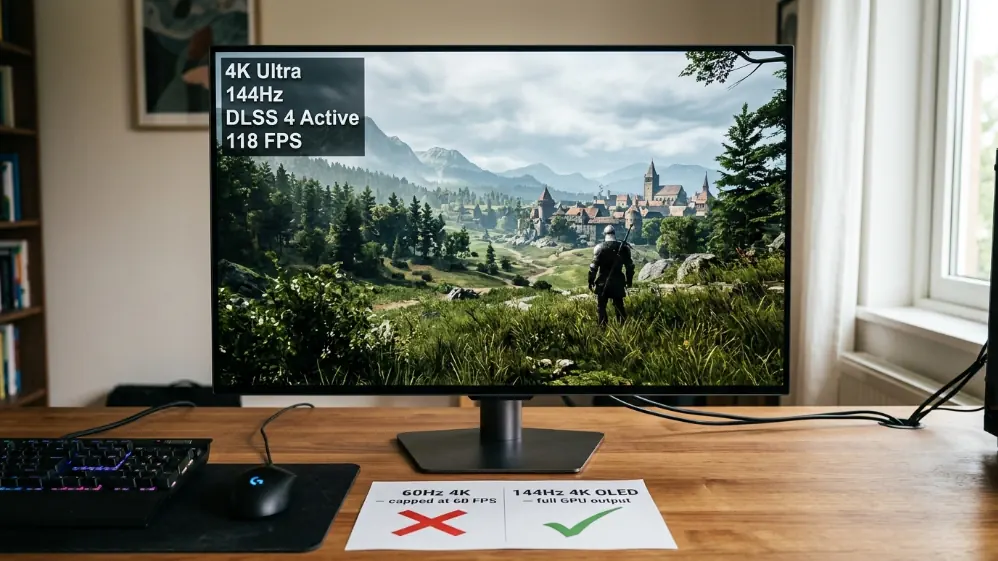
A 4K build without a 4K monitor is just a 1440p build spending more money, beyond that, a 60Hz 4K panel caps you at 60 FPS no matter what the GPU can actually deliver, spend over a grand on a GPU and pair it with a 144Hz 4K OLED, otherwise the hardware never gets to show what it can do.
Expected performance
| GPU | 4K Native Avg FPS | With DLSS/FSR Quality |
|---|---|---|
| RX 9070 XT | ~60 FPS | ~80–100 FPS (FSR 4) |
| RTX 5070 Ti | ~60+ FPS | ~100–140+ FPS (DLSS 4) |
| RTX 5080 | ~75–85 FPS | ~130–180+ FPS (DLSS 4 MFG) |
Source: Tom’s Hardware GPU Hierarchy and RTX 5070 Ti review, GamersNexus RTX 5080 and 5070 Ti benchmarks
The verdict
The RX 9070 XT build at $1,860–2,200 is where 4K gaming starts in 2026, sixty FPS at 4K ultra, 16GB VRAM, FSR 4 when you need a lift, if budget is the ceiling, this is the build.
The RTX 5070 Ti build at $2,270–2,600 earns its price if DLSS 4 is part of how you play, MFG changes the 4K experience in single-player games in ways that native frame rates alone don’t show, whether the extra $400–600 over the 9070 XT build makes sense depends entirely on what you play.
The RTX 5080 at $1,249 is solid performance with a price that’s hard to defend against the 5070 Ti. Catch one near MSRP and it’s a strong buy, at street pricing, most people are better off with the 5070 Ti.
The RTX 5090 is for a different kind of build, if you’re already there, you know.
Pingback: Best Editing and Gaming Hybrid PC Under $1200 - Fragtrix
Pingback: Ryzen 7 9800X3D Review: Best Gaming CPU in 2026? - Fragtrix
Pingback: Budget Streaming Gaming PC Build Under $900 - Fragtrix