building a solid 1440p gaming PC in march 2026 is brutally more expensive than it was six months ago, and i’m going to be upfront about it the $1,200 price point that used to be the sweet spot for high refresh 1440p gaming is dead.
This 1440p ultra gaming pc build guide covers exactly what changed. the AI-driven memory shortage has fundamentally reshaped what you can build at every budget tier, and the reality is harsher than most build guides want to admit.
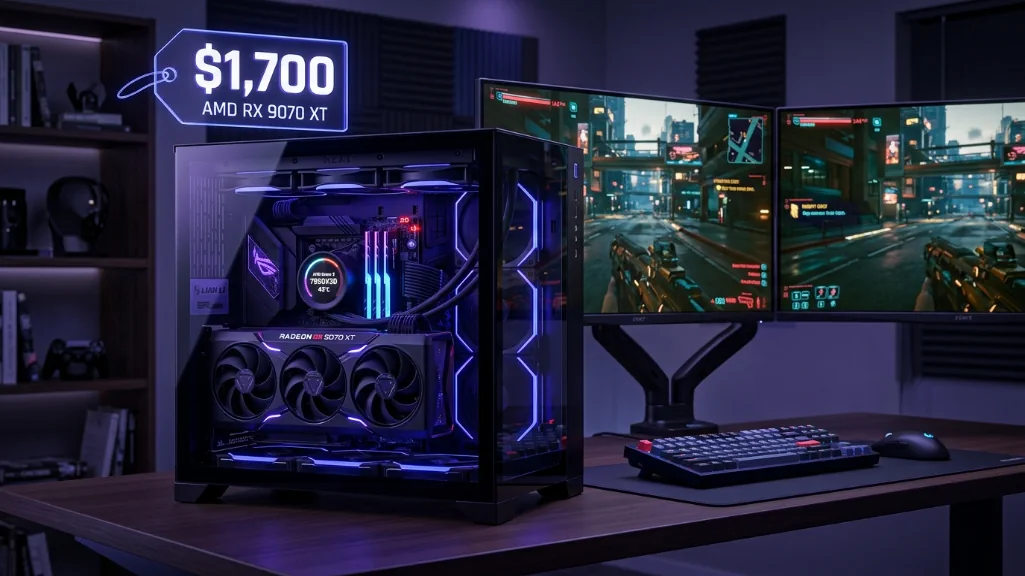
here’s where things actually stand: a properly equipped 1440p ultra system with 32GB RAM, a competitive GPU, and no major compromises now runs somewhere in the $1,700-1,900 range. if you’re willing to accept meaningful tradeoffs starting with 16GB of RAM, choosing a slightly weaker GPU you can squeeze into the $1,400-1,550 range, anything below that requires stacking compromises that undermine the whole point of a “1440p ultra” build.
this guide uses verified march 2026 pricing from amazon, newegg, and price tracking tools, no wishful thinking, no “catch it on sale for $200 less” fantasies. let’s talk about what it actually costs right now.
The brutal reality of building in march 2026
The AI memory crisis hit harder than anyone expected
the unprecedented AI infrastructure buildout consumed massive amounts of silicon production capacity, and DDR5 memory manufacturing took a devastating hit. production facilities shifted focus to HBM (high bandwidth memory) for AI accelerators, and the GDDR7 memory needed for NVIDIA’s RTX 5000 series strained the supply chain even further.
the result? DDR5 prices haven’t just doubled they’ve tripled to quadrupled since mid 2025, depending on the specific kit and timing. tom’s hardware reported that the US RAM crisis reached a boiling point, with all 32GB DDR5 kits under $359 wiped from the market entirely. premium DDR5-6000 CL30 kits from brands like G.Skill, Corsair, and TeamGroup now routinely sell for $480-600+.
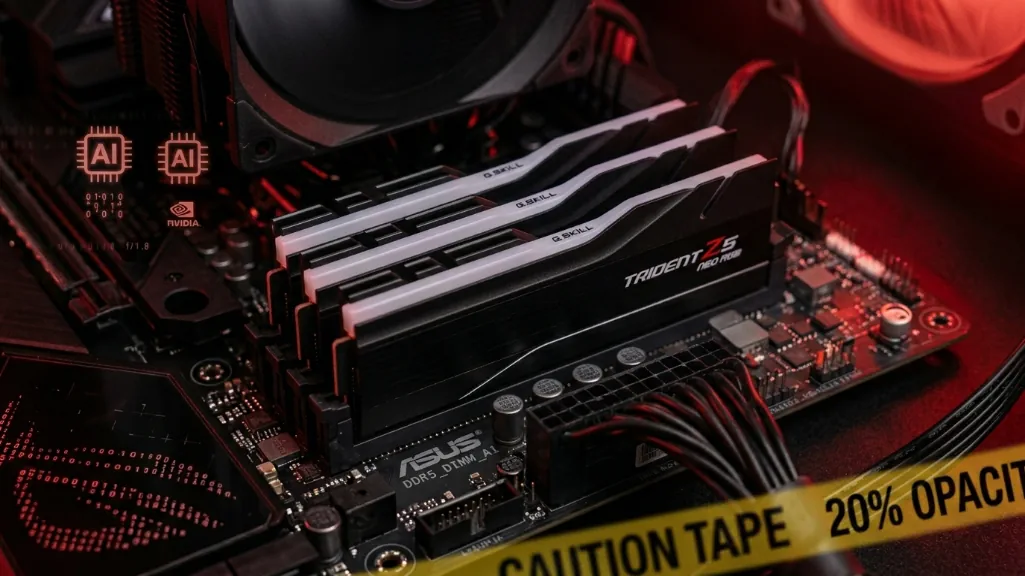
a 32GB DDR5-6000 CL30 kit that was going for around $88-100 in mid 2025 is now commanding $480-520 or more for name-brand options, that single component added $380-420 to every gaming build, and it didn’t just impact the budget it fundamentally broke the price structure for mid range gaming PCs.
What $1,200 gets you now (spoiler: not much)
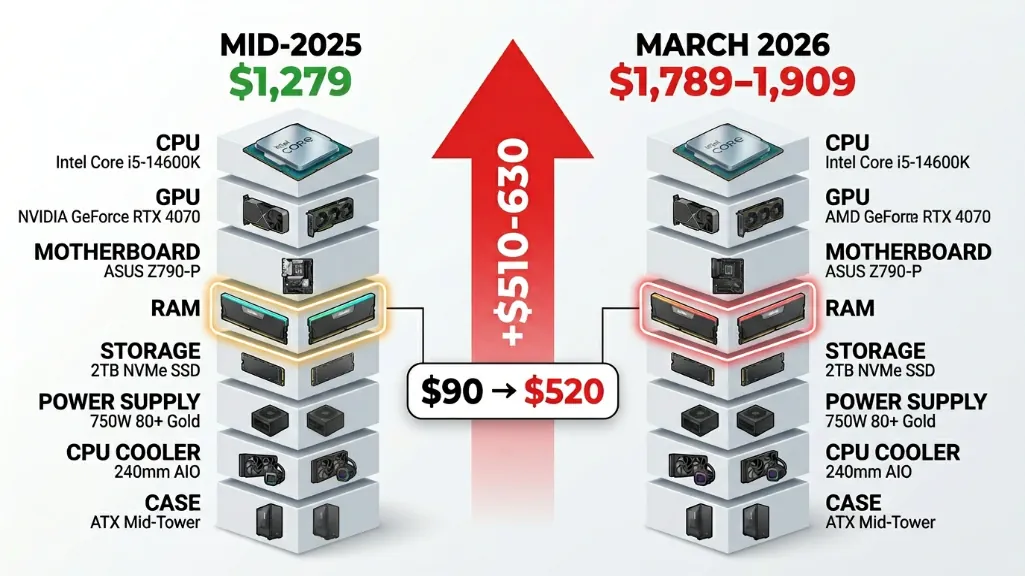
let me break down what a realistic mid-2025 build looked like versus march 2026:
mid-2025 ($1,200 total):
- ryzen 5 9600X: ~$180
- RX 9070 XT: $599
- 32GB DDR5-6000: ~$90
- B650 motherboard: $155
- 1TB NVMe: $85
- 750W gold PSU: $100
- case: $70
- total: approximately $1,279
march 2026 reality same config, current prices:
- ryzen 5 9600X: $189 (stable)
- RX 9070 XT: around $650-730 (+$50-130)
- 32GB DDR5-6000 CL30: roughly $480-520 (+$390-430)
- B650 motherboard: $165 (+$10)
- 1TB NVMe: $85 (unchanged)
- 850W gold PSU: approximately $125 (+$25)
- case: $70 (unchanged)
- cooler: $25 (now needed)
- total: around $1,789-1,909
that memory price explosion jumping from around $90 to roughly $480-520 represents over 70% of the total cost increase, when a single component adds $400+ to your build, it doesn’t just shift the budget it obliterates the entire mid-range price tier.
the realistic budget for proper 1440p ultra performance with 32GB RAM and no compromises is now somewhere in the $1,700-1,900 range. if you’re locked at $1,400-1,500, you’re looking at starting with 16GB RAM and upgrading when (and if) prices normalize, or choosing a weaker GPU tier.
The GPU decision: your most critical choice
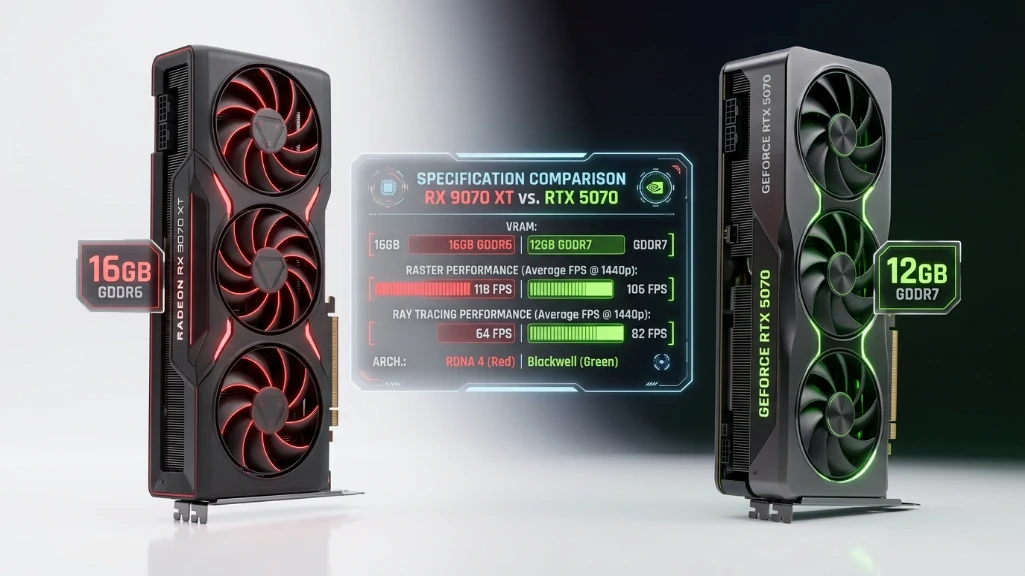
at this budget level, your GPU choice determines around 60-70% of your actual gaming performance, this is where you can’t afford to compromise, and thankfully there are options though prices are elevated across the board.
AMD RX 9070 XT 16GB: best rasterization for the money
the RX 9070 XT has established itself as the strongest value proposition in the current GPU landscape, though “value” is a relative term in march 2026.
that 16GB of VRAM is genuinely critical in 2026. titles like star wars outlaws, hogwarts legacy, and the last of us part 1 can push VRAM usage above 12GB at ultra texture quality, the RX 9070 XT gives you that headroom without compromise.
rasterization performance is where this card shines. in traditional gaming without ray tracing, independent benchmarks from techspot and gamers nexus consistently show the RX 9070 XT competing with and sometimes beating the RTX 5070 Ti in rasterized workloads.
verified performance at 1440p ultra without ray tracing (approximate averages):
- cyberpunk 2077: around 109-136 fps depending on scene and driver version (techspot measured 125 fps, gamers nexus 109 fps at launch, with subsequent driver updates adding roughly 9% improvement)
- hogwarts legacy: approximately 85-100 fps
- resident evil 4: around 118-130 fps
- CS2: roughly 220-270 fps (this card underperforms relative to its tier in CS2 specifically)
- competitive titles generally: 200-300+ fps
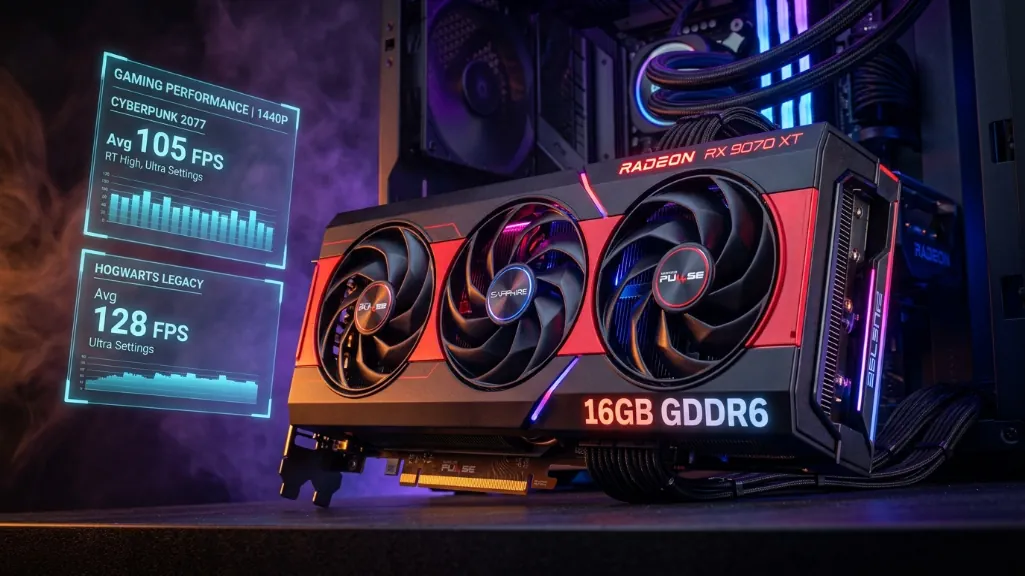
with AMD’s FSR 4 quality mode enabled, demanding titles gain 30-50% in frame rates, though FSR 4 game support is still catching up to NVIDIA’s DLSS ecosystem.
current street pricing sits at roughly $650-730 for AIB models on amazon. the MSRP was raised to $619 following GDDR6 cost increases, and most retail cards sell well above that. the sapphire pulse occasionally drops to $650, while premium models like XFX mercury or powercolor red devil push $750-790.
AMD RX 9070 16GB: complicated value proposition
the non-XT version deserves mention but comes with a major caveat: AMD is reportedly prioritizing 9070 XT production over the non-XT, since both cards use the same amount of memory (16GB, eight chips) but the XT commands a higher price. availability for the regular 9070 is inconsistent.
when you can find it, the RX 9070 delivers roughly 88-92% of the XT’s rasterized performance with the same 16GB VRAM. techspot measured it matching the RTX 5070 in cyberpunk 2077 at 1440p and beating it by 15% in raw rasterization.
the problem is pricing. with the MSRP raised to $569 and actual retail hovering around $620-700 for in-stock models, the price gap to the 9070 XT has narrowed to the point where the XT often makes more sense if you can find stock.
NVIDIA RTX 5070 12GB: DLSS 4 and Ray Tracing Excellence
the RTX 5070 brings genuinely impressive AI powered features, but you need to go in with eyes open about its limitations.
DLSS 4 with multi-frame generation is the real differentiator. in heavy ray tracing scenarios, the NVIDIA stack is meaningfully ahead not by the 15-20% the internet casually throws around, but by 30-55% or more in path-traced workloads like cyberpunk 2077 overdrive mode.
gamers nexus testing showed the RTX 5070 leading the 9070 XT by 55% in cyberpunk ray tracing at 1440p upscaled. in black myth wukong with RT, the gap is even larger it’s not a close comparison.
if you’re a content creator or streamer, the NVENC encoder remains genuinely superior to AMD’s VCN encoder at lower bitrates.
the 12GB VRAM problem: this is the RTX 5070’s achilles heel. at 12GB on a 192-bit bus, VRAM saturation is a real issue at 1440p ultra in demanding games. gamers nexus documented erratic frametime performance and heavy stuttering when the 5070 exceeds its VRAM capacity particularly in cyberpunk with RT at higher resolutions. the RX 9070 XT’s 16GB provides significantly more headroom for the next 2-3 years.
current street pricing: around $595-650 on amazon. the $549 MSRP founders edition occasionally appears at best buy but sells out instantly, at these prices, the RTX 5070 is positioned awkwardly the RX 9070 offers better raw rasterization and more VRAM for similar money.
Which one should you actually buy?
for pure rasterization and future VRAM headroom at this budget, the RX 9070 XT makes the most sense for most people. the 16GB buffer means you won’t be compromising on textures through 2028, and the rasterized performance is excellent.
go with the RTX 5070 only if ray tracing is a genuine priority for you, if you stream or record content regularly, or if you play a lot of RT-heavy titles. DLSS 4 is legitimately impressive technology, and the RT performance advantage is substantial not marginal.
CPU sweet spot: the easy decision
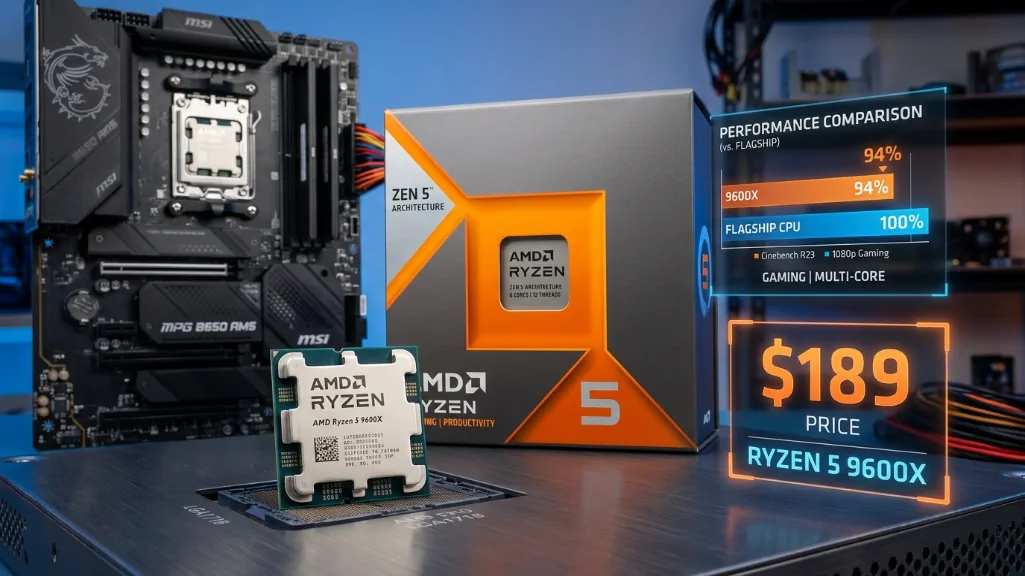
Ryzen 5 9600X: $189 for 90-95% of flagship performance
this is the most straightforward recommendation in the entire build. the ryzen 5 9600X sits at $189 on amazon (verified march 21, 2026) and delivers roughly 90-95% of the gaming performance of much more expensive CPUs when gaming at 1440p.
why? because at 1440p and above, you’re almost always GPU-limited. the difference between a $189 CPU and a $350+ CPU translates to maybe 3-8 fps measurable in benchmarks, imperceptible during gameplay.
the 9600X is a 6-core, 12-thread chip on AMD’s zen 5 architecture. it boosts to 5.4 GHz, draws only 65W under typical gaming loads, and uses the AM5 platform that AMD has committed to supporting through at least 2027.
paired with an RX 9070 XT at 1440p ultra (based on verified benchmarks), you’re looking at approximately 105-130 fps in cyberpunk 2077, around 85-100 fps in hogwarts legacy, roughly 200-260 fps in CS2, and approximately 90-110 fps in demanding open-world titles.
the upgrade path is compelling: buy the 9600X now, save $160-200 versus a 7800X3D or 9800X3D, put that money toward your GPU or RAM, and upgrade the CPU in 2027 when high-end chips hit the used market.
When to spend more on the CPU
the ryzen 7 7800X3D ($350-390) makes sense if you’re playing competitive games on a 240Hz+ monitor where the 96MB L3 cache translates to measurably better 1% lows. it also helps significantly in simulation and strategy games cities skylines 2, total war, paradox titles.
but for most people building in 2026? the 9600X is the smarter allocation of budget. every dollar saved here goes toward the components that actually bottleneck your experience.
The 32GB RAM situation (the budget killer)
Why 16GB isn’t enough for ultra settings
in 2026, 16GB actively limits your gaming experience in new AAA releases at ultra settings. when modern games max out available memory, windows pages to your SSD, causing microstutters and inconsistent frame pacing that make gameplay feel janky despite healthy GPU usage numbers.
games that are problematic on 16GB systems include star wars outlaws (stuttering above high textures), hogwarts legacy (recommends 32GB for ultra), cities skylines 2 (needs 24GB+ for large cities), and modern warfare 3 (recommends 24GB for 1440p ultra textures). add discord, a browser, and streaming software and 16GB becomes genuinely limiting.
32GB is the target for a proper 1440p ultra build in 2026. the question is whether you buy it now or start with 16GB and upgrade.
The painful reality of DDR5 pricing
this is where the build math falls apart for budget conscious builders. DDR5-6000 CL30 the sweet spot for AM5 ryzen systems is shockingly expensive in march 2026.
current verified pricing for 32GB (2x16GB) DDR5-6000 CL30 kits:
- G.Skill RipJaws S5: around $480
- G.Skill Trident Z5 NEO RGB: approximately $520
- Corsair Vengeance (non-RGB): roughly $480-520
- Corsair Vengeance RGB: approximately $520-560
- TeamGroup T-Force Delta RGB: around $500-600
there is no $260 kit. there is no $300 kit from a reputable brand. the cheapest name brand 32GB DDR5-6000 CL30 kits start around $480 and go up from there.
when will prices drop? industry analysts are not optimistic. trendforce projected 55-60% DRAM price increases for Q1 2026, and multiple sources indicate prices will continue climbing through mid-2026. new manufacturing capacity from SK hynix and micron won’t meaningfully affect consumer DDR5 supply until late 2027 at the earliest. don’t plan your budget around a price drop that isn’t coming soon.
if you’re budget constrained, the realistic approach is buying a 16GB DDR5-6000 CL30 kit for roughly $200-260 now and upgrading to 32GB when (and if) the market stabilizes, it’s not ideal for ultra settings, but it works for competitive games and less demanding titles.
Three 1440p ultra gaming PC build paths for march 2026
Build A: $1,400-1,550 budget (meaningful compromises)
this is the most affordable path to a system that can still call itself a 1440p gaming PC, but with clear limitations.
| component | model | approximate price |
|---|---|---|
| CPU | AMD ryzen 5 9600X | $189 |
| GPU | AMD RX 9070 XT 16GB (sapphire pulse or similar) | ~$650 |
| RAM | 16GB DDR5-6000 CL30 | ~$220 |
| motherboard | MSI B650 gaming plus wifi | $165 |
| storage | 1TB gen 4 NVMe SSD | $85 |
| PSU | 850W 80+ gold modular | ~$125 |
| case | deepcool CC560 mesh or similar | $65 |
| cooler | thermalright assassin X 120 | $25 |
| windows | unactivated (free) | $0 |
| total | approximately $1,524 |
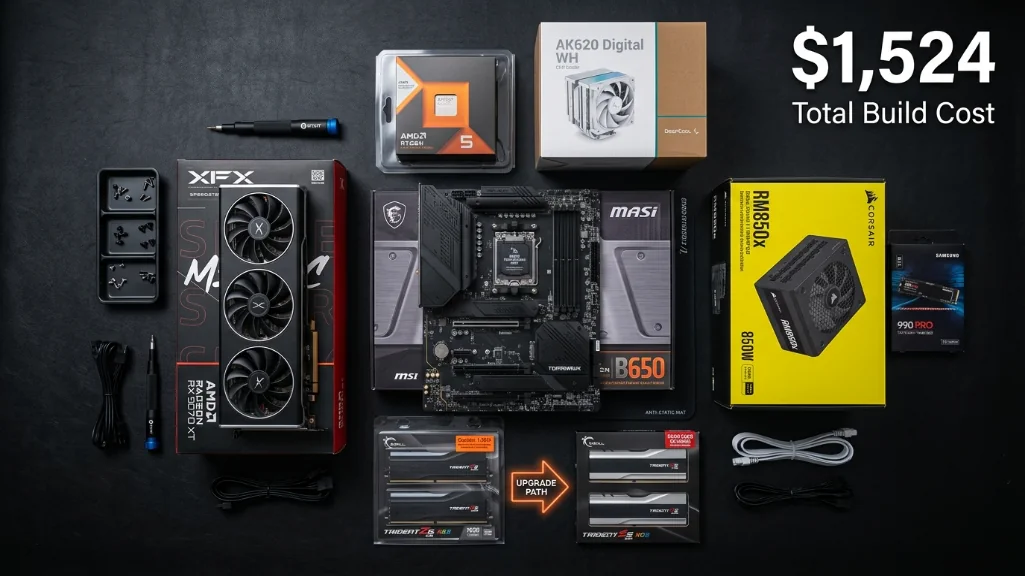
with strategic shopping and sales: $1,430-1,530 is realistic.
compromises accepted:
- 16GB RAM instead of 32GB plan to add another 16GB kit when prices allow. some demanding titles will need high instead of ultra textures
- 850W PSU provides headroom for future GPU upgrades
expected performance at 1440p ultra (approximate, some games may need high textures due to 16GB RAM):
- cyberpunk 2077: around 109-136 fps
- hogwarts legacy: approximately 80-95 fps (may need high textures)
- call of duty MW3: roughly 110-130 fps
- CS2: around 220-270 fps
- resident evil 4: approximately 118-130 fps
upgrade path: add a second 16GB DDR5 kit when prices stabilize. total eventual cost: approximately $1,650-1,800.
Build B: $1,700-1,900 recommended (no compromises)
this is the proper 1440p ultra build. no texture compromises, no RAM limitations, proper headroom.
| component | model | approximate price |
|---|---|---|
| CPU | AMD ryzen 5 9600X | $189 |
| GPU | AMD RX 9070 XT 16GB | ~$650-730 |
| RAM | 32GB DDR5-6000 CL30 | ~$480-520 |
| motherboard | MSI B650 gaming plus wifi | $165 |
| storage | 1TB gen 4 NVMe SSD | $85 |
| PSU | 850W 80+ gold modular | ~$125 |
| case | montech AIR 903 MAX or similar | $70 |
| cooler | thermalright assassin X 120 | $25 |
| windows | unactivated (free) | $0 |
| total | approximately $1,789-1,909 |
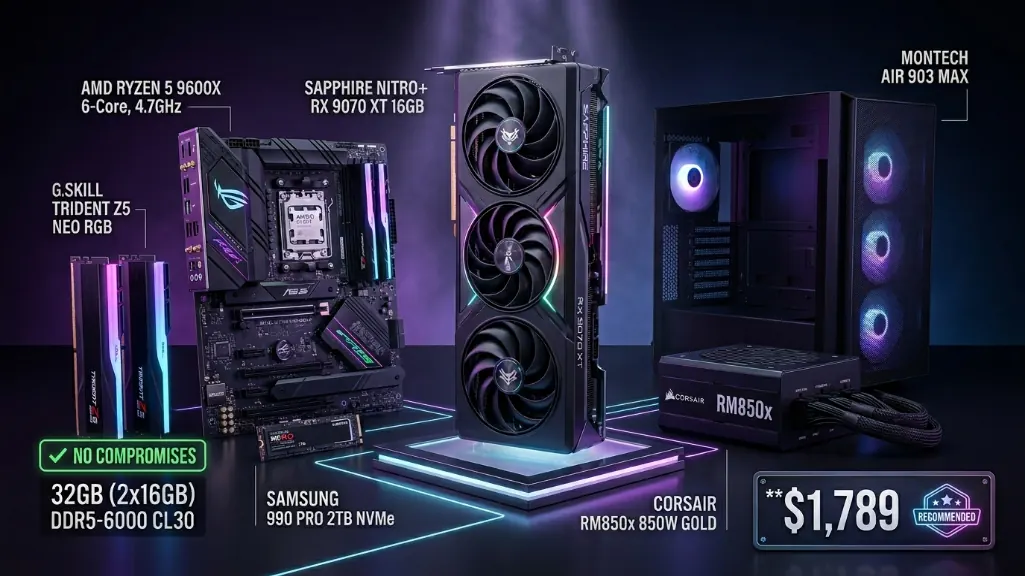
with strategic shopping: $1,720-1,850 is achievable.
expected performance at 1440p ultra (approximate ranges from verified benchmarks):
- cyberpunk 2077: around 109-136 fps
- hogwarts legacy: approximately 85-100 fps
- star wars outlaws: roughly 85-105 fps
- resident evil 4: around 118-130 fps
- last of us part 1: approximately 90-106 fps
- CS2: roughly 220-270 fps
- valorant: 300+ fps
- apex legends: around 180-210 fps
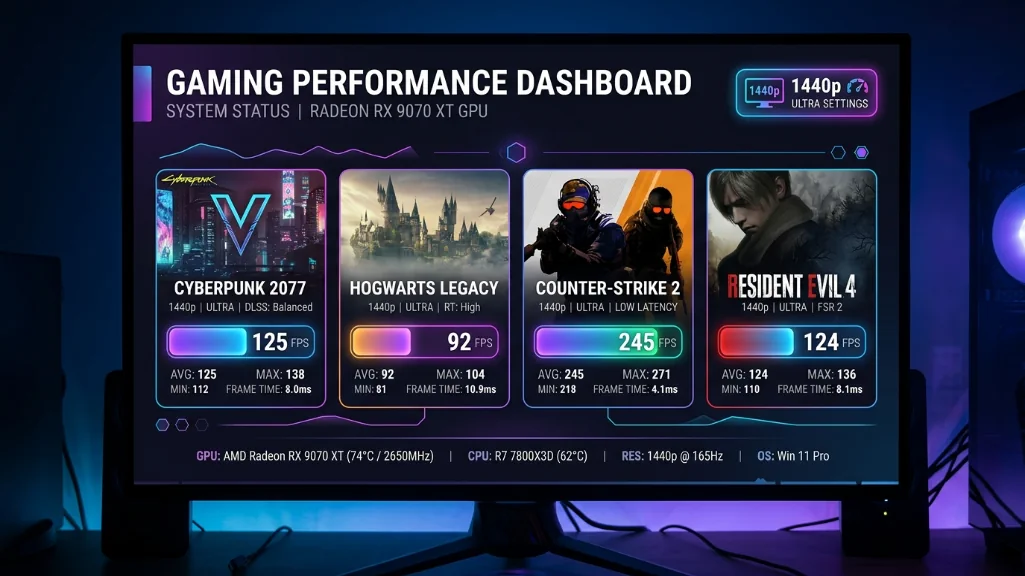
these are approximate performance ranges based on professional reviews from techspot, gamers nexus, and hardware unboxed with driver maturation factored in. actual results vary by 5-15% depending on driver versions, specific scene complexity, background processes, and silicon lottery.
why this build works:
- 32GB RAM eliminates texture compromises and background task stuttering
- 16GB VRAM from RX 9070 XT ensures no VRAM bottlenecks through 2028
- 850W PSU provides headroom for GPU upgrades
- AM5 platform supports CPU upgrades through 2027+
Build C: RTX 5070 ray tracing variant ($1,700-1,850)
if ray tracing is your priority, swap the GPU:
changes from Build B:
- GPU: RTX 5070 12GB instead of RX 9070 XT (~$595-650)
- slight savings on GPU, but 12GB VRAM is a long-term concern
- approximate total: $1,735-1,850
tradeoffs:
- substantially better ray tracing performance (30-55% ahead of 9070 XT in RT)
- superior DLSS 4 upscaling quality
- excellent NVENC encoder for streaming
- but only 12GB VRAM may need texture compromises in 2027-2028
- weaker rasterized performance in most non RT scenarios
Should you wait or build now?
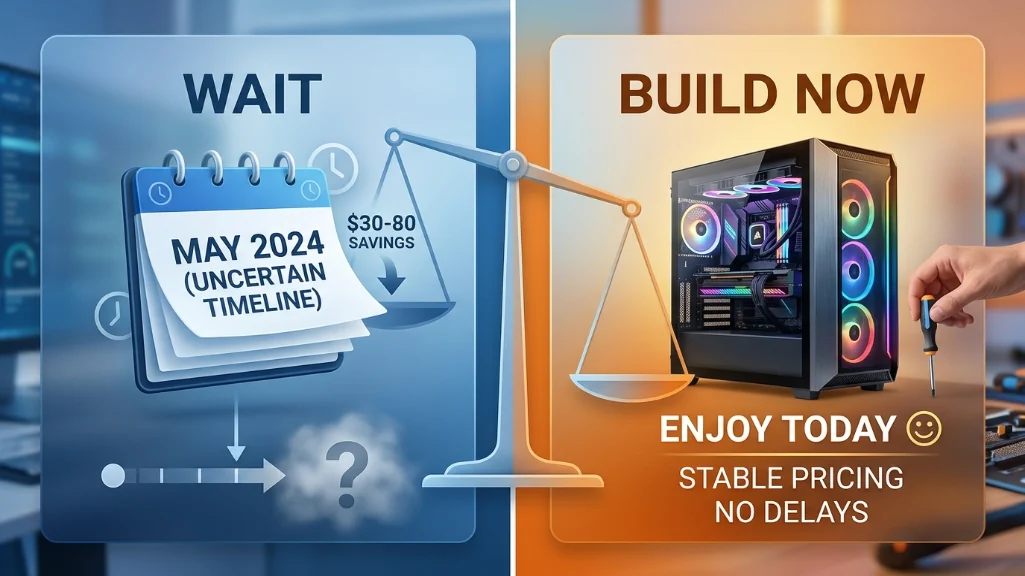
The Case for waiting (tempered expectations)
if your current PC is still functional, there are reasons to hold off but don’t expect dramatic savings.
GPU prices are gradually trending downward from their 2025 peaks. the RX 9070 XT hit $975 at its worst and has settled to the $650-730 range. further softening to $620-670 is possible by mid-2026.
the RTX 5060 Ti 16GB, which launched in april 2025 at $429 MSRP, is currently selling around $435-549 depending on model and retailer, if it pushes closer to MSRP consistently, it adds another solid option for budget-minded builders, though it’s a significant performance step down from the RX 9070 XT.
what you won’t save on: RAM. industry analysts do not forecast meaningful DDR5 price relief until late 2027 at the earliest. new manufacturing capacity is focused on HBM for AI, not consumer DDR5. if anything, prices may continue climbing through mid-2026. do not delay your build expecting a RAM price drop it’s not coming in the near term.
realistic savings from waiting 3-4 months:
- GPU: potentially $30-80 if trends continue
- RAM: unlikely to improve, may worsen
- total potential savings: roughly $30-80
When building now makes sense
build now if your current PC is dead or struggling, if you have time off to enjoy the system, or if you find a strong deal on the GPU, the current market is harsh but stable you’re not going to miss a dramatic price collapse by buying today.
if you’re tightly budget-constrained, the 16GB RAM compromise path (Build A at $1,430-1,550) lets you game now and upgrade memory later. it’s the pragmatic approach in a market that isn’t getting friendlier anytime soon.
The bottom line
building a capable 1440p ultra gaming PC in march 2026 requires facing some uncomfortable budget realities, the $1,200 sweet spot is gone. the $1,300-1,400 range that some guides still recommend is misleading it only works by citing prices that don’t exist in today’s market.
if you want 32GB RAM and a strong GPU with no compromises, budget $1,700-1,900 for Build B. if that’s too steep, Build A at $1,430-1,550 with 16GB RAM and a planned upgrade is the honest budget path.
the GPU choice comes down to priorities, the RX 9070 XT at roughly $650-730 delivers the best rasterization and 16GB VRAM for long-term relevance. the RTX 5070 at $595-650 offers superior ray tracing and DLSS 4 but only 12GB VRAM. the regular RX 9070 at $620-700 (when available) gives 88-92% of the XT’s performance at a slight discount.
the ryzen 5 9600X at $189 remains the CPU sweet spot 90-95% of flagship gaming performance at less than half the cost.
and the elephant in the room: DDR5 pricing isn’t recovering soon. analysts point to late 2027 before meaningful relief arrives. plan your budget accordingly, don’t wait for a price drop that isn’t coming, and accept that memory alone now costs as much as a mid-range GPU did two years ago.
this is likely the most expensive era for building a gaming PC since the crypto mining crisis, and unlike that bubble, the structural supply constraints driving DDR5 prices aren’t going away quickly. build smart with realistic expectations, and you’ll still end up with an excellent gaming system it just costs more than any of us would like.