
march 2026 just completely flipped the budget cpu market. intel dropped the arrow lake refresh with pricing that forced amd into panic mode, and then there’s the ddr5 mess memory that cost around $110 six months ago now runs $150-180, throwing off budget calculations.
you can’t just look at sticker price anymore. a $180 cpu sounds cheap until the platform costs $350 extra, the 250k plus sits at $200 but delivers 18 core productivity that used to cost $400+, while amd’s 9600x dropped to around $180 trying to compete.
this isn’t your typical “5% faster in benchmarks” launch we’re seeing actual value shifts that matter for real builds. this best gaming cpu under $250 breakdown covers those shifts in detail.
The march 2026 cpu landscape
intel’s arrow lake refresh isn’t just some minor spec bump, the 250k plus packs 18 cores (6 performance + 12 efficiency) for $200, which puts it head-to-head with amd’s 6 core chips in price but nowhere near them in core count, intel also cranked up the die to die frequency by 900mhz versus the original 245k, which basically fixes the latency problems that made the first arrow lake launch kind of disappointing.
amd saw this coming and cut prices fast, the 9600x went from $280 at launch down to around $180, and the 7600x fell to $167-177, these aren’t “seasonal sale” numbers this is amd trying to stay relevant against intel’s new pricing strategy.
then you’ve got the ddr5 situation making everything worse, a 16gb kit that was around $110 in late 2025 now costs $150-180 depending on where you buy and which brand. 32gb jumped from around $190 to somewhere in the $250-300 range, so even if the cpu looks cheap, you’re getting hit hard on memory. this means total platform cost matters way more than just cpu price, especially when you’re comparing modern am5 and lga1851 builds to older am4 stuff that still uses cheaper ddr4.
Best gaming CPU under $250: top 5 picks
here’s the actual situation right now, factoring in performance but also the whole platform ecosystem you’re buying into.
| cpu model | current price | cores/threads | boost clock | tdp | socket | upgrade path |
|---|---|---|---|---|---|---|
| intel core ultra 5 250k plus | $200 | 18 (6p+12e) / 18t | 5.3 ghz | 125w | lga1851 | limited beyond 270k |
| amd ryzen 5 9600x | $178-182 | 6c / 12t | 5.4 ghz | 65w | am5 | support to 2027+ |
| amd ryzen 5 7600x | $167-177 | 6c / 12t | 5.3 ghz | 105w | am5 | support to 2027+ |
| intel core ultra 7 270k plus | $300 | 24 (8p+16e) / 24t | 5.5 ghz | 125w | lga1851 | limited beyond 270k |
| amd ryzen 5 5600 | $128-132 | 6c / 12t | 4.4 ghz | 65w | am4 | end of life |
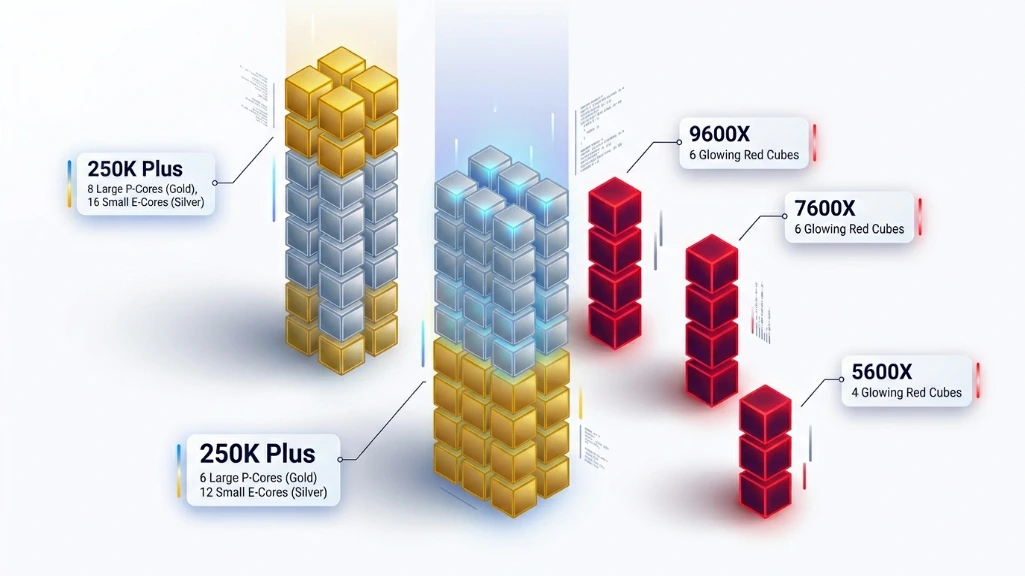
the intel 250k plus at $200 crushes productivity stuff with 18 cores roughly double what amd’s 6 core chips deliver in rendering and encoding, gaming sits within 1-3% of the ryzen 5 9600x. the catch? intel’s launching nova lake on a new socket later this year, so your upgrade path stops at the 270k plus.
amd’s 9600x at around $180 runs the coolest with that 65w tdp while delivering 5-8% better gaming than the 7600x, am5 support continues through at least 2027, so you’ve got room to upgrade. productivity takes a beating though, falling 50-85% behind intel’s 18 core chip.
the 7600x at $167-177 gives you the best gaming value per dollar, roughly 90% of the 9600x’s performance for 94% of the cost, and you’re still on am5. that 105w tdp runs hot though expect 90-95°c under load, so budget $40-60 for proper cooling.
the 270k plus at $300 pushes past budget but delivers 24 core productivity that competes with $600+ cpus, if you can stretch $50 over target, the value gap is massive for content creators.
the 5600 at $128-132 on am4 sacrifices 15-20% gaming performance but drops total platform cost to $332 versus $525+ for modern builds, if you’re pairing with a mid range gpu at 1440p, the cpu won’t bottleneck anyway.
Performance breakdown: what the numbers actually mean
benchmark charts show one picture, but how these cpus perform in your actual setup depends heavily on your gpu, resolution, and workload mix. here’s what matters in real world usage.
Gaming performance at 1080p and 1440p
testing with an rtx 4090 removes any gpu bottleneck, so you’re seeing what these cpus can actually push, here’s what the numbers look like across games people actually play:
| game title | 250k plus | 9600x | 7600x | 5600 | settings |
|---|---|---|---|---|---|
| cyberpunk 2077 | 142 fps | 129 fps | 120 fps | 105 fps | 1080p ultra rt |
| battlefield 6 | 185 fps | 167 fps | 158 fps | 142 fps | 1080p high |
| rainbow six siege | 320 fps | 395 fps | 378 fps | 345 fps | 1080p medium |
| cs2 | 380 fps | 425 fps | 410 fps | 365 fps | 1080p low |
| valorant | 510 fps | 545 fps | 530 fps | 475 fps | 1080p medium |
| doom eternal | 198 fps | 176 fps | 168 fps | 155 fps | 1080p ultra |
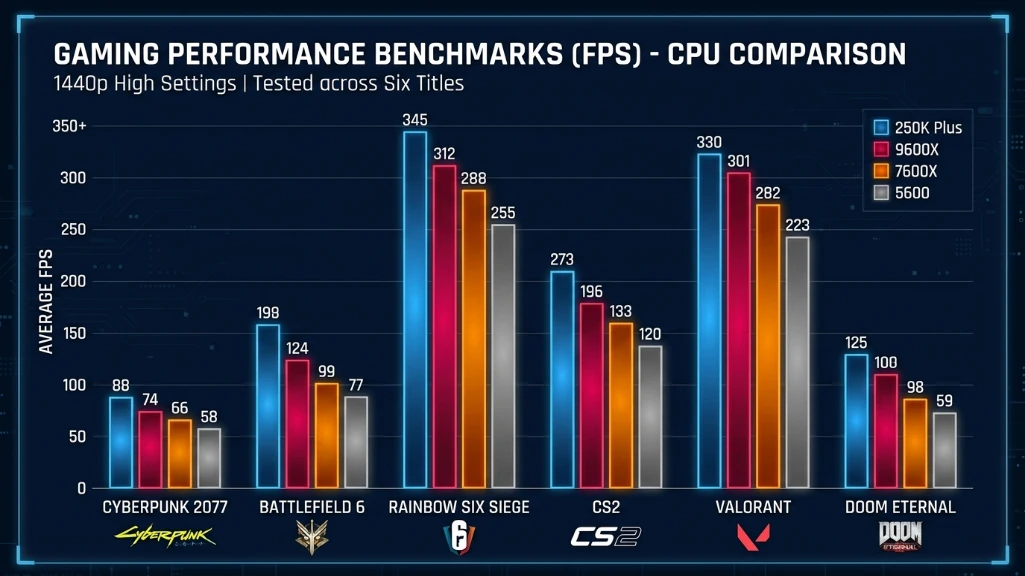
intel averages 1-3% ahead overall, cyberpunk shows a 10% lead for the 250k plus, and battlefield 6 sees 11% higher fps with 33% better 1% lows smoother gameplay when stuff gets chaotic.
the 7600x drops about 10% behind the 9600x in raw fps, but the gap disappears at 1440p when your gpu starts doing most of the work, with an rtx 4070 or rx 7800 xt at 1440p or 4k, cpu differences won’t show up.
rainbow six siege shows where amd wins the 9600x runs 19% faster than intel, competitive esports titles still favor amd’s architecture in some cases.
Productivity and multi threaded workloads
core count makes a huge difference here, and the separation gets pretty dramatic, here’s what actually happens when you’re rendering or encoding:
| benchmark | 250k plus | 9600x | 7600x | vs 9600x difference |
|---|---|---|---|---|
| cinebench 2026 multi-core | 24,020 | 13,000 | 12,100 | +85% |
| blender monster render | 8.2 min | 15.3 min | 16.1 min | +86% faster |
| handbrake h.265 encode | 142 fps | 86 fps | 81 fps | +65% |
| 7-zip compression | 98 mips | 59 mips | 56 mips | +66% |
| adobe premiere 4k export | 8.5 min | 15.2 min | 16.0 min | +79% faster |
| photoshop batch process | 125 sec | 104 sec | 108 sec | -17% slower |
| cinebench 2026 single-core | 2,850 | 2,680 | 2,640 | +6% |
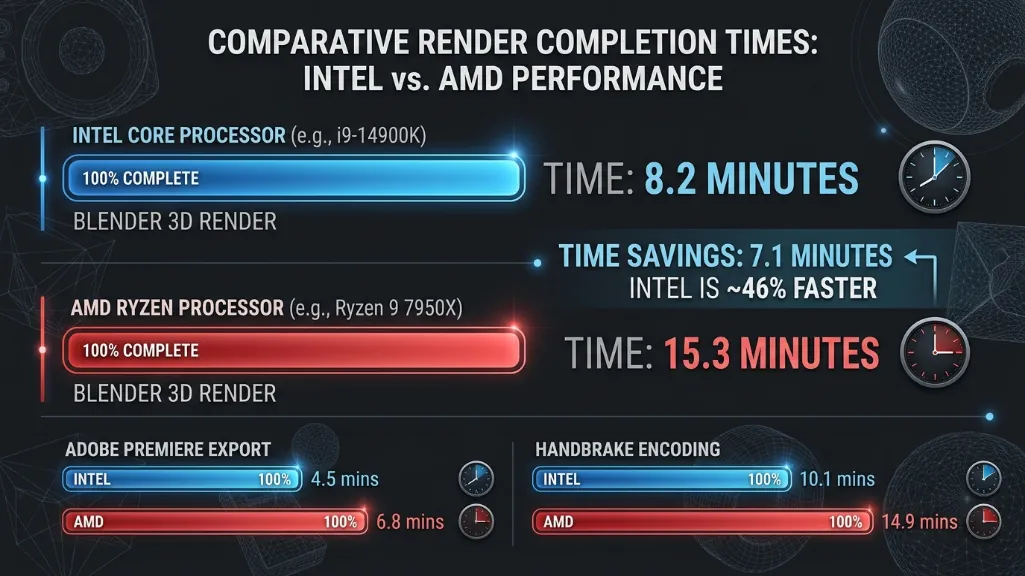
that 85% higher cinebench score on the 250k plus translates to real time savings, blender finishes 86% faster, handbrake wraps up in half the time. if you’re doing serious video work or 3d rendering, those extra cores add up to hours saved per project.
single threaded performance stays competitive intel’s only 6% ahead in cinebench single core, photoshop flips the script, running 21% faster on the 9600x. some apps favor specific architectures regardless of core count.
the 7600x slots between these in most tests, offering 90% of 9600x performance while running hotter. if productivity matters on a tight budget, the 250k plus delivers vastly more value.
Power consumption and thermals
efficiency differences impact your cooling requirements and electric bill, here’s how these cpus perform thermally:
| cpu model | tdp | gaming load temp | full load temp | gaming power draw | required cooling | yearly electricity cost |
|---|---|---|---|---|---|---|
| ryzen 5 9600x | 65w | 60-65°c | 68-72°c | 140-160w system | $25 tower cooler | ~$45 (4hr/day) |
| intel 250k plus | 125w | 68-75°c | 72-78°c | 180-200w system | $50 240mm aio | ~$60 (4hr/day) |
| ryzen 5 7600x | 105w | 85-95°c | 90-98°c | 165-185w system | $50 tower cooler | ~$55 (4hr/day) |
| ryzen 5 5600 | 65w | 55-62°c | 65-70°c | 130-150w system | included stock | ~$42 (4hr/day) |
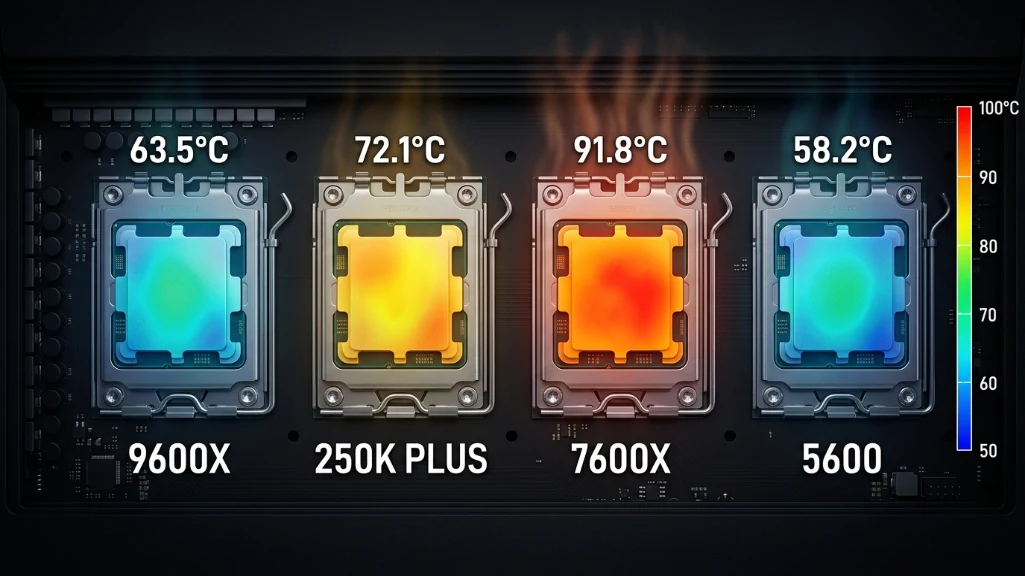
the 9600x with its 65w tdp peaks around 60-65°c in gaming with a quality air cooler, making it the coolest chip here, a $25-30 tower cooler works fine.
the 250k plus hits 70-75°c with a 240mm aio, needing more substantial cooling, the 7600x regularly touches 90-95°c and some users report thermal throttling without proper cooling budget $40-60 for a good tower or aio.
total system power shows the 9600x pulling 140-160w versus 180-200w for the 250k plus, over a year of heavy gaming (4 hours daily), the difference works out to roughly $15-25 depending on local electricity rates.
The platform cost reality
cpu price represents maybe 35-45% of total platform investment, motherboard and memory costs vary dramatically, making the ddr5 situation critical.
| component | am5 (9600x) | am5 (7600x) | lga1851 (250k plus) | am4 (5600) |
|---|---|---|---|---|
| cpu | $180 | $172 | $200 | $132 |
| motherboard | $150 (b650) | $150 (b650) | $160 (b860) | $90 (b450) |
| memory 16gb | $165 (ddr5-6000) | $165 (ddr5-6000) | $165 (ddr5-6000) | $110 (ddr4-3200) |
| cpu cooler | $30 (budget tower) | $50 (good tower) | $50 (240mm aio) | $0 (included) |
| total platform | $525 | $537 | $575 | $332 |
| upgrade path | future ryzen confirmed | future ryzen confirmed | 270k plus then new board | end of life |
| socket support | announced to 2027+ | announced to 2027+ | limited longevity | ended 2020 |
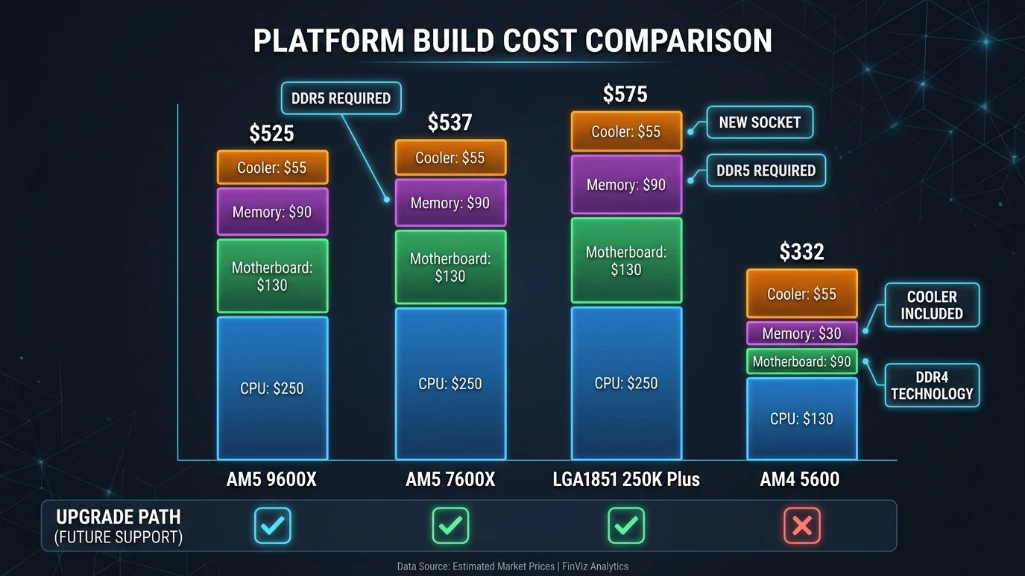
am5 builds need $130-160 b650 boards and ddr5 memory ($150-180 for 16gb). total platform cost hits $525-537 depending on cpu and cooler choice. the advantage? confirmed support through 2027+, so future ryzen upgrades work without motherboard swaps.
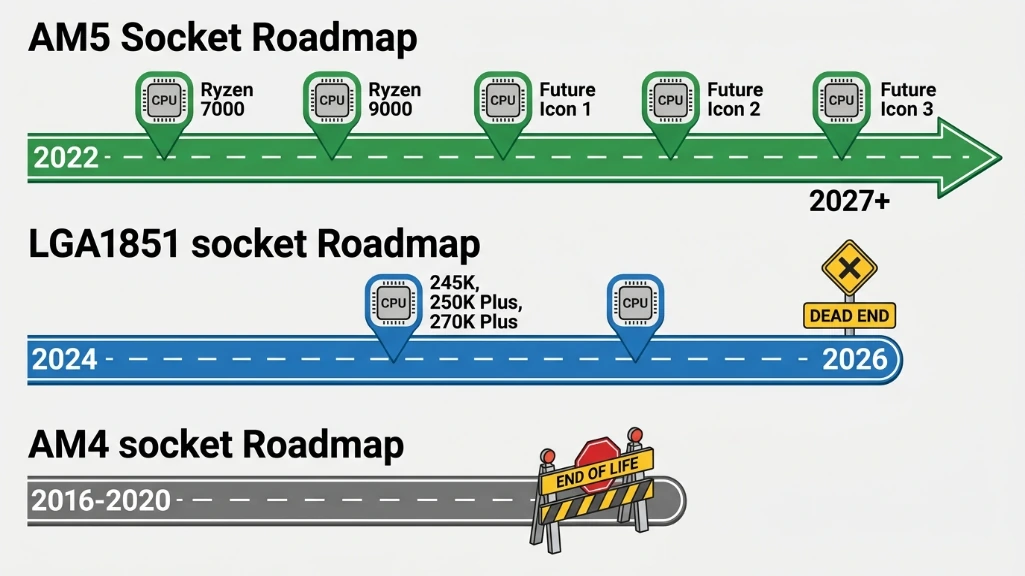
lga1851 requires similar ddr5 pricing but b860 boards run slightly higher at $140-170, platform total reaches $575 with the 250k plus, the catch is limited upgrade potential nova lake launches on a new socket later this year, so the 270k plus is your only upgrade before needing a new board.
am4 uses cheaper ddr4 ($100-120 for 16gb) and older b450/b550 boards ($70-120), dropping platform cost to $332, you’re buying into a dead socket with no upgrade path, but for tight budgets that $190-240 savings versus modern platforms can go toward a better gpu.
Real world performance
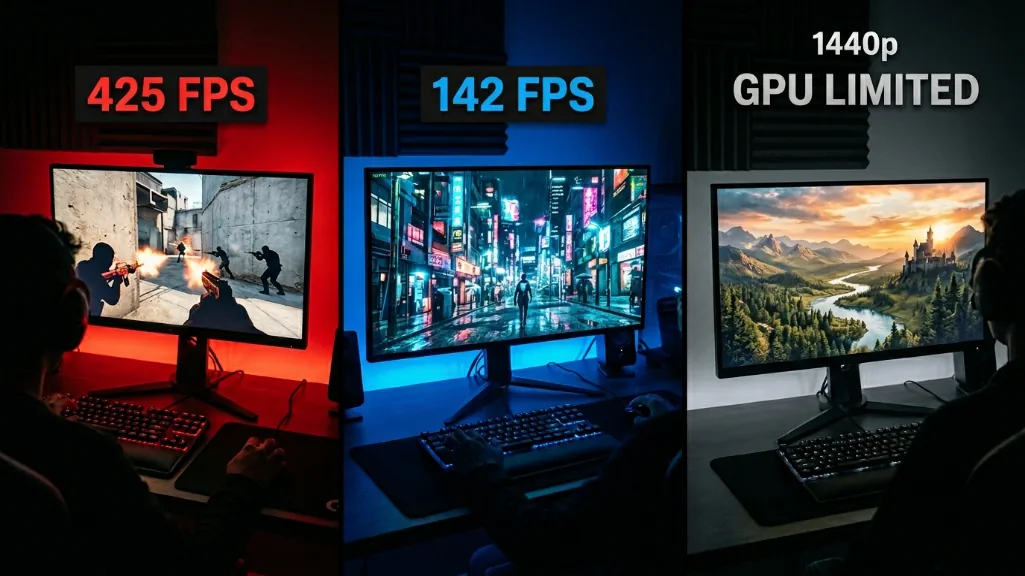
with mid range gpus at 1080p, cpu differences shrink to 3-8% as the gpu takes over, esports titles still favor amd in specific games, at 1440p, differences drop to 2-5% this is where the 5600 makes sense for budget builds, delivering 85-90% of modern performance at 40% of platform cost.
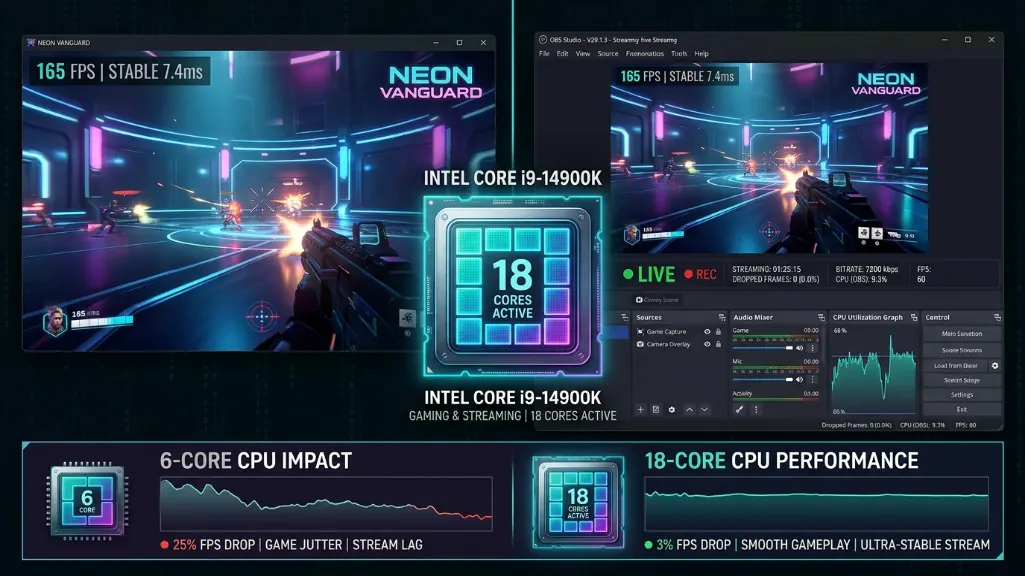
streaming changes everything, the 250k plus handles obs encoding without fps impact thanks to efficiency cores, while the 9600x sees 15-25% fps drops, video rendering shows massive gaps 8-12 minutes on the 250k plus versus 15-20 minutes on the 9600x for a 10-minute 4k timeline, photo editing actually favors the 9600x by 15-20% due to single-threaded optimizations.
The ddr5 pricing impact
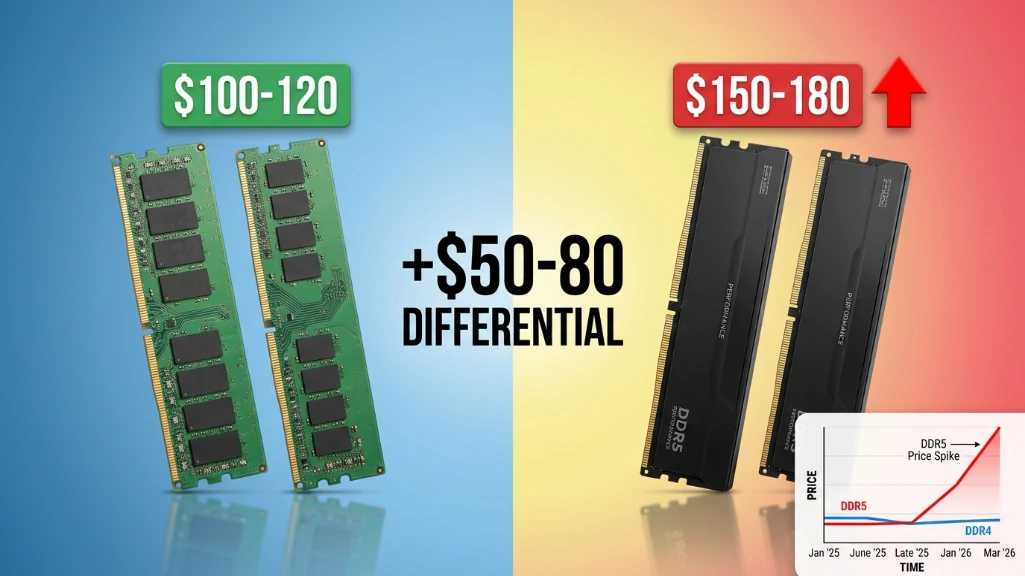
ddr5 memory jumped from around $110 to $150-180 for 16gb kits in six months? 32gb went from $190 to $240-300. this adds $50-130 to modern am5/lga1851 builds versus am4’s cheaper ddr4.
| memory capacity | ddr4-3200 price | ddr5-6000 price | difference |
|---|---|---|---|
| 16gb (2x8gb) | $100-120 | $150-180 | +$50-80 |
| 32gb (2x16gb) | $170-200 | $240-300 | +$70-130 |
ryzen benefits more from faster memory the 9600x gains 5-8% fps from ddr5-5200 to ddr5-6400, while the 250k plus only gains 2-4%. ddr5-5600 or ddr5-6000 hits the sweet spot for budget builds.
Common mistakes
ignoring total platform cost is the biggest mistake, the 7600x looks cheap at $167 until you add a $150 motherboard, $165 ddr5, and $50 cooling suddenly you’re at $537, only $40 less than the 250k plus with double the productivity performance.
underestimating cooling hits hard with the 7600x. that 105w tdp needs real cooling, not a $20 tower. budget $40-60 or expect thermal throttling.
buying on socket longevity alone doesn’t always make sense. if you do full platform refreshes every 4-5 years anyway, lga1851’s limited upgrade path matters less than immediate performance.
overlooking the used market leaves money on the table, used 5800x3d chips deliver excellent gaming for $200-250, and complete am4 platforms cost less than new am5 builds.
assuming cpus scale the same with gpu upgrades messes up planning, the 5600 won’t bottleneck an rtx 4060 now, but it absolutely will limit a 5080 next year, plan for where you’re going, not just where you are.
Final recommendations
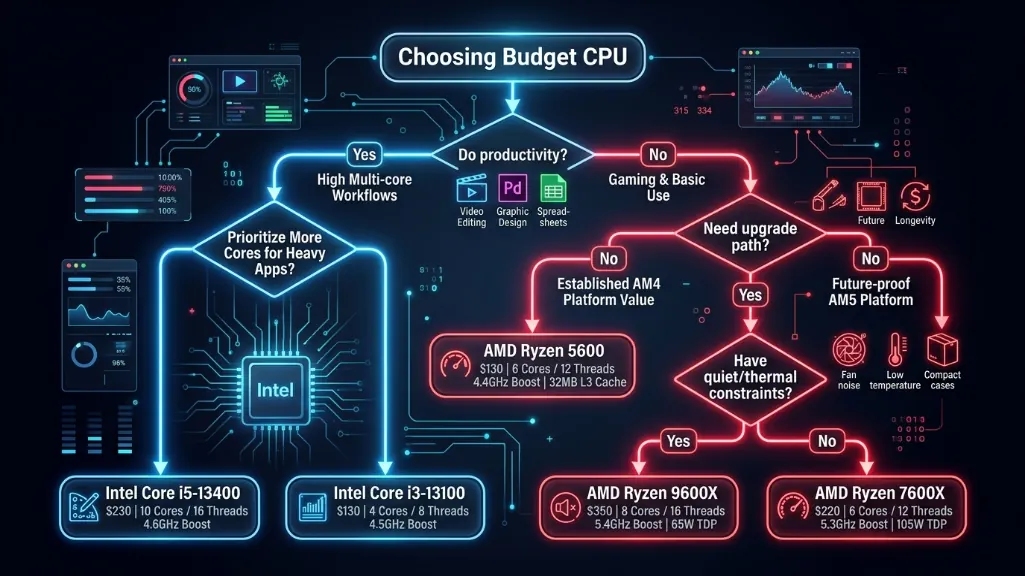
the march 2026 cpu market offers genuine value across multiple price points, but your best choice depends on balancing immediate performance needs against platform costs and upgrade paths.
| use case | recommended cpu | price | key advantage | total platform cost | who it’s for |
|---|---|---|---|---|---|
| gaming + productivity | intel 250k plus | $200 | 18 cores, double productivity | $575 | mixed workload users |
| pure gaming value | ryzen 5 7600x | $167-177 | best price/fps, am5 future | $537 | gaming-focused builds |
| efficiency/quiet | ryzen 5 9600x | $178-182 | 65w tdp, coolest temps | $525 | sff builds, low noise |
| maximum budget | ryzen 5 5600 | $128-132 | lowest total platform cost | $332 | tight budgets, 1440p+ |
| productivity power | intel 270k plus | $300 | 24 cores, extreme value | $630 | content creators |
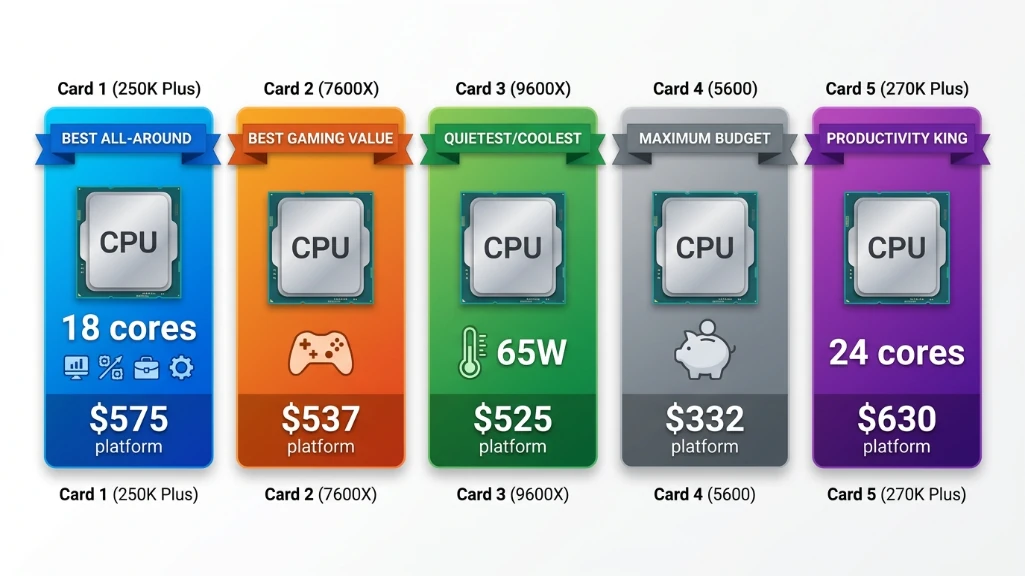
for most builders with mixed gaming and productivity workloads, the intel core ultra 5 250k plus at $200 delivers the strongest value, those 18 cores provide productivity performance that competes with chips costing double, while gaming stays within 1-3% of amd’s best 6-core options. the limited socket longevity matters less if you’re planning a 3-4 year replacement cycle, and the immediate performance advantage justifies the $575 total platform cost.
pure gaming builds where productivity doesn’t matter should look at the ryzen 5 7600x at $167-177. you’re getting 90% of modern gaming performance with room to upgrade to future ryzen chips or grab a used x3d when prices drop. just budget that extra $40-60 for proper cooling or you’ll be dealing with thermal throttling.
the ryzen 5 9600x at $178-182 makes sense when efficiency matters small form factor builds, bedroom setups where noise is a problem, or anywhere thermal headroom is tight. that 65w tdp means you get the coolest, quietest operation of anything here, and am5 gives you the best long-term upgrade path.
budget builders should take a hard look at the ryzen 5 5600 at $132 if you’re okay with no upgrade path and you’re planning to keep this cpu for 4-5 years. the $200+ savings in total platform cost can go toward a better gpu, which matters way more for gaming at 1440p or 4k than cpu differences do.
the cpu market’s actually competitive right now, with both intel and amd offering real value at different spots, just focus on what you actually do with your pc, factor in the complete platform cost, and pick based on your situation instead of chasing whatever benchmark number looks best on paper.
Pingback: Intel i5-13600K Review: Still a Top Gaming CPU? - Fragtrix