Beyond Enemy Lines Vietnam is shaping up to be an interesting option for players who enjoy military shooters with a more tactical feel. While some will naturally compare it to Gray Zone Warfare, the game seems to follow a different path. It appears closer to a blend of tactical sandbox combat and the structure of modern Call of Duty campaigns, where missions feel guided but still leave room for exploration.
One of the biggest differences is scale. The campaign is not built around a full squad, which immediately makes the experience feel tighter and more controlled. Instead of trying to recreate a large-team battlefield simulation, the game seems focused on smaller-scale coordination, more deliberate movement, and a stronger sense of tension during missions.
The mission structure also helps it stand apart. Rather than using one continuous open world, Beyond Enemy Lines Vietnam moves between directed missions and larger open areas. That choice could work well for players who want freedom without losing momentum, especially in a military shooter where pacing matters.
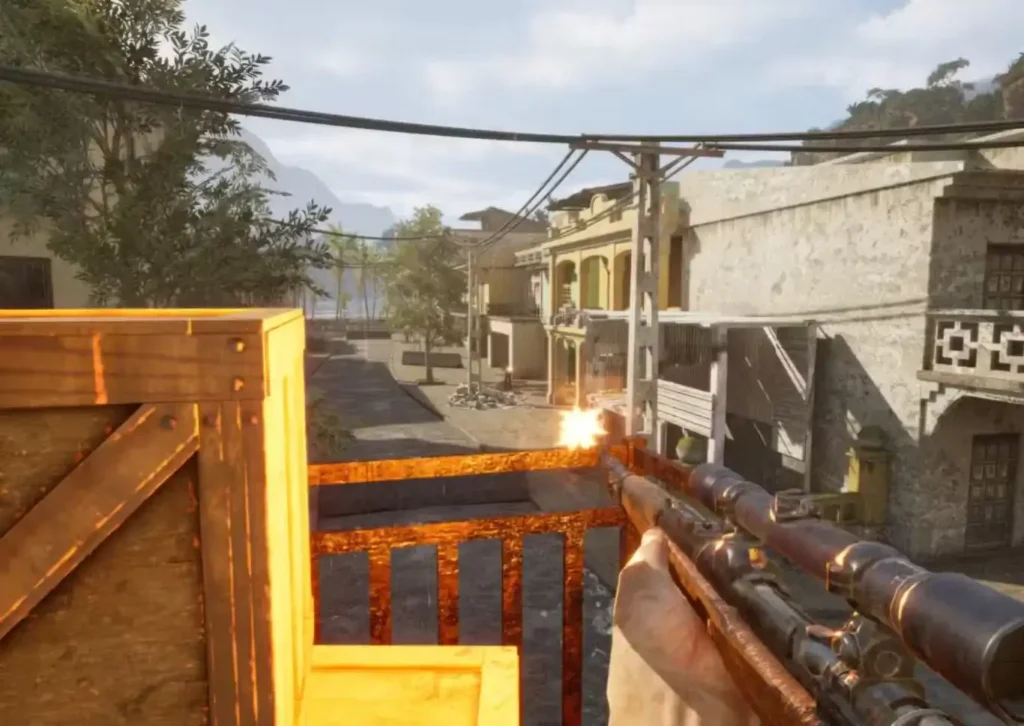
Its setting is one of the clearest highlights. Dense jungle environments, military compounds, villages, hidden paths, and tunnels all point to a Vietnam War atmosphere built around pressure and uncertainty. The terrain itself looks like part of the challenge, not just a backdrop, which could make exploration and movement as important as the firefights.
Combat seems designed around player choice. Stealth, sniping, direct assaults, and vehicle-supported movement all appear to be part of the experience. That flexibility matters, because it gives players more than one way to handle the same situation and helps the game feel less scripted from one encounter to the next.
Weapon progression and customization should add another layer to that freedom. Attachments and upgrades appear to give players more control over how their loadout performs, whether the goal is accuracy, stability, or close-range effectiveness. The game also tracks player performance, which adds a useful sense of progression beyond simply clearing missions.
The campaign, however, is only one part of the package. The game is also planned to include smaller objective-based scenarios, co-op content, and PvP modes, although not all of that is expected to be available immediately at the start of early access. If handled well, that gradual rollout could actually benefit the game by giving the developers time to improve systems and respond to player feedback before everything is fully in place.
What really gives Beyond Enemy Lines Vietnam long-term potential is its planned mission editor. That feature could end up being the game’s real advantage. Instead of relying only on developer-made content, players would be able to create their own maps, missions, and combat scenarios inside the game itself.
If the editor is easy to use and the dynamic AI works well inside player-made content, the game could gain a much longer life than most military shooters. Community-created missions and PvP maps often keep games active far beyond their original launch window, especially when players are given the freedom to build and share their own ideas.
Taken together, Beyond Enemy Lines Vietnam looks less like a simple war shooter and more like a game trying to combine tactical combat, mission variety, and player creativity in one package. If it delivers on those ideas, it could become one of the more interesting military shooters to watch.