
Short answer: yes, longer answer: it’s complicated; but not in a way that changes the conclusion.
The Ryzen 7 9800X3D launched in November 2024 at $479 and immediately took the top spot in gaming CPU benchmarks by a margin nobody at Intel was comfortable with. A year and a half later, in May 2026, it’s sitting at around $438 – 440 on Amazon, the 9850X3D has technically passed it by 3.3% on average, and AMD’s own Zen 6 is lurking somewhere on the roadmap, so where does that leave the 9800X3D?
Still at the top, let’s get into it. This ryzen 7 9800x3d review breaks down whether it’s still worth buying against the 9850X3D and Intel’s best.
Ryzen 7 9800X3D review: specs
| Spec | Ryzen 7 9800X3D |
|---|---|
| Architecture | Zen 5 |
| Cores / Threads | 8C / 16T |
| Base Clock | 4.7 GHz |
| Boost Clock | 5.2 GHz |
| L3 Cache | 96MB 3D V-Cache + 8MB L2 = 104MB total |
| TDP | 120W |
| Platform | AM5 (DDR5, PCIe 5.0) |
| Process | TSMC 4nm |
| Launch MSRP | $479 |
| Current Price (May 2026) | ~$438–440 |
| Overclocking | Fully unlocked |
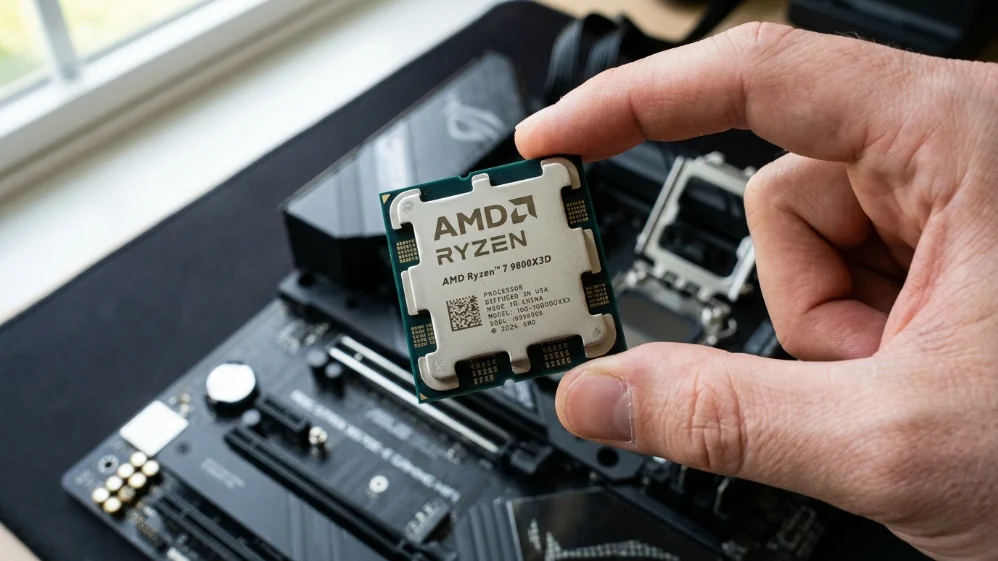
96MB of 3D V-Cache stacked L3, Zen 5 architecture, 5.2 GHz boost, and full overclocking support, the last point being new for the X3D line, specs alone don’t win gaming benchmarks though, cache architecture and how the chip uses it does.
The cache architecture: Why it hits differently
The cache moved: and it matters
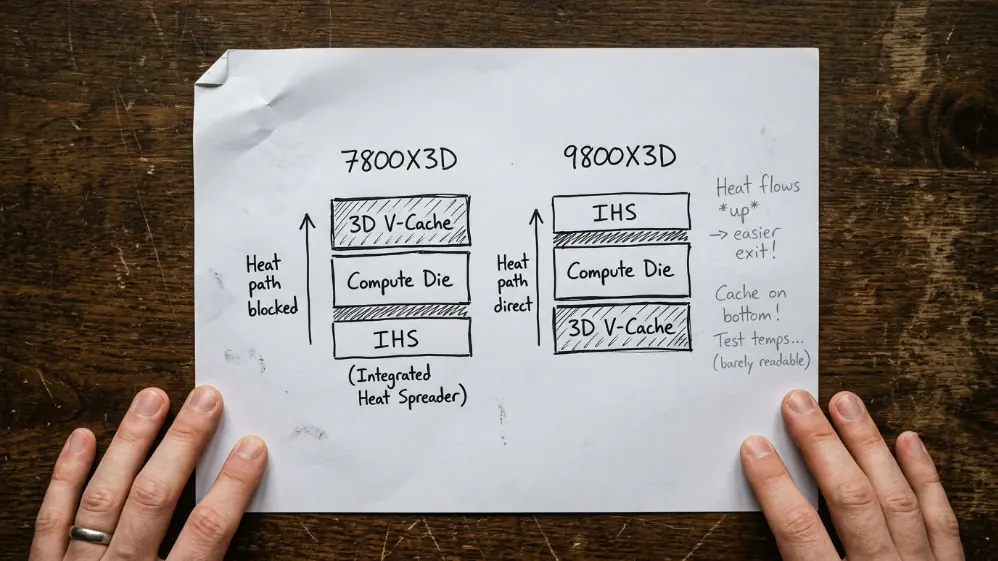
On the 7800X3D, the 3D V-Cache chiplet sat on top of the compute die, that created a thermal problem, heat from the compute die had to pass through the cache to reach the IHS, limiting clock speeds.
AMD flipped it for the 9800X3D, the cache now sits underneath the compute die, giving the IHS direct contact with the compute die itself, more thermal headroom means higher sustained clock speeds. During gaming, the 9800X3D runs at an average of 5.2 GHz, roughly 10% faster than the 7800X3D’s average clock according to Tom’s Hardware’s testing, that clock advantage stacks on top of the cache advantage, which is why the gen-on-gen improvement ended up larger than AMD’s own conservative estimates.
Why cache matters so much for gaming
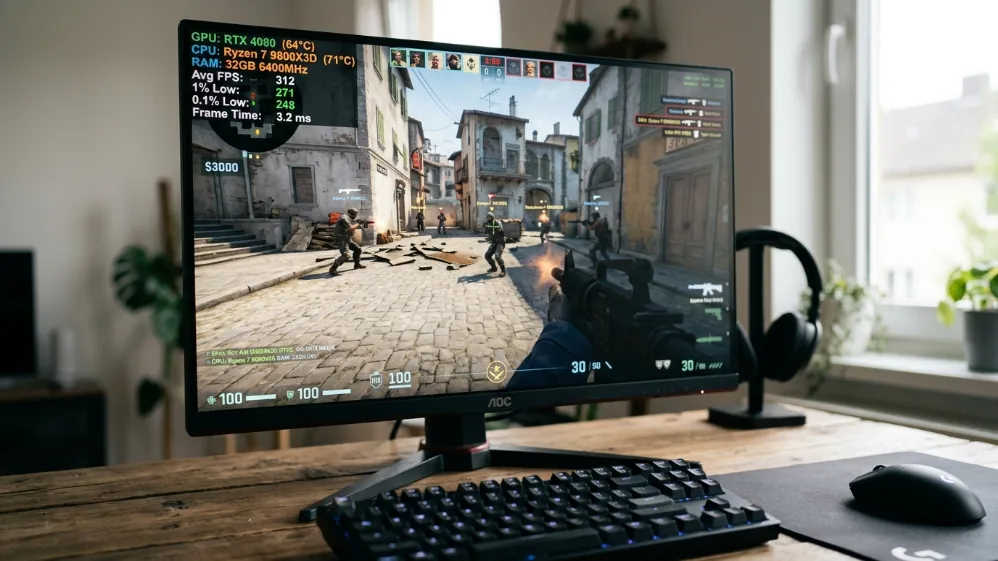
Modern games, particularly CPU-intensive titles, constantly pull data from memory, when that data fits in the L3 cache, access latency drops dramatically compared to hitting DRAM, the 9800X3D’s 96MB L3 is large enough to keep the most frequently accessed game data on-chip for longer. The result shows up most clearly in 1% low frame rates; the frames that determine how smooth a game actually feels, not just what the average says.
Gaming performance: The numbers that matter
Against Intel
Against Intel’s current flagship Core Ultra 9 285K, the 9800X3D leads by 35% in Tom’s Hardware’s 13-game test suite, Against the Core i9-14900K, still popular in many rigs, the gap is 30% on average, Intel’s Core Ultra 7 270K Plus actually leads in single-threaded workloads, but single-threaded performance doesn’t translate to gaming the way cache-optimized architecture does.
Tom’s Hardware’s 2026 CPU guide says it directly: Intel isn’t a factor in gaming right now; that’s a sentence that would have been unthinkable five years ago.
Against the 7800X3D
AMD claimed 8% improvement over the 7800X3D, Tom’s Hardware measured 14.7% in their test suite, AMD was being conservative, which is rare enough to be worth noting. The real difference varies significantly by title.
| Game | 7800X3D vs 9800X3D Gap | Source |
|---|---|---|
| Baldur’s Gate 3 (Act 3) | 9800X3D +25% | Tom’s Hardware |
| Hogwarts Legacy | 9800X3D +21% | TechSpot |
| Counter-Strike 2 (avg) | 9800X3D +12.8% | Hardware Unboxed |
| CS2 (1% lows) | 9800X3D +13.8% | Hardware Unboxed |
| Total War: Warhammer 3 | Near tie | PCBuildHelper |
In GPU-bound scenarios at 4K, the gap collapses, both chips are effectively waiting for the GPU, the 9800X3D’s advantage is most visible at 1080p and 1440p in CPU-bound titles, which covers most competitive and AAA single-player gaming at high refresh rates.
1% Lows: The smoothness story
Average FPS is only part of gaming performance. The 9800X3D’s 1% low frame rates are genuinely exceptional, Tom’s Hardware measured 1% lows at 148 fps, which is only 2.5% slower than the Core Ultra 9 285K’s average frame rate, In practice, that means the 9800X3D’s worst frames during a gaming session are nearly as good as Intel’s typical frames, for competitive players, that consistency matters more than peak numbers.
Should you buy the 9850X3D instead?
The 9850X3D launched in early 2026 and technically reclaimed the title of “world’s fastest gaming CPU” from the 9800X3D, but barely, Tom’s Hardware’s review measured a 3.3% average performance advantage for the 9850X3D. It costs around $500 versus the 9800X3D’s $438–440.
Here’s the kicker: the 9800X3D can match the 9850X3D with simple PBO (Precision Boost Overdrive) settings, Tom’s Hardware confirmed this, You enable PBO in BIOS, get roughly 2.6% additional performance for free, and the gap between the two chips essentially evaporates, there’s almost no scenario where the 9850X3D makes more sense than the 9800X3D at current prices.
What about the 7800X3D?
This is where it gets genuinely interesting for budget-conscious buyers, the 7800X3D in May 2026 is sitting at $324–360, and has occasionally dipped to $324 in deals, around $110–115 cheaper than the 9800X3D.
It’s still around 7– 8% slower than the 9800X3D in gaming in 2026, in most titles and most resolutions, that gap is invisible, if you’re pairing a 7800X3D with an RTX 5070 at 1440p, you’re not leaving meaningful performance on the table.
The case for the 9800X3D is straightforward though: if you’re building fresh today on AM5, there’s no platform cost to pay, you get 14.7% better gaming performance on average, better 1% lows, fully unlocked overclocking, and the newest architecture, the $110 premium buys real improvements on a new build.
The case for the 7800X3D: if you’re on AM4 and considering an AM5 upgrade specifically to get the 9800X3D, the math becomes harder, you’d be paying for a new motherboard, DDR5 RAM, and the CPU itself; all to get to a chip that games 7– 8% faster than the 7800X3D in most scenarios.
Overclocking and efficiency
PBO and curve optimizer
The 9800X3D is the first X3D chip fully unlocked for overclocking, PBO adds around 2.6% gaming performance with minimal effort; just enable it in BIOS and let AMD’s algorithms do the work. The Curve Optimizer goes further, letting you undervolt the chip to lower temperatures and power consumption while maintaining or improving performance. The 9800X3D responds well to this approach.
Power and cooling
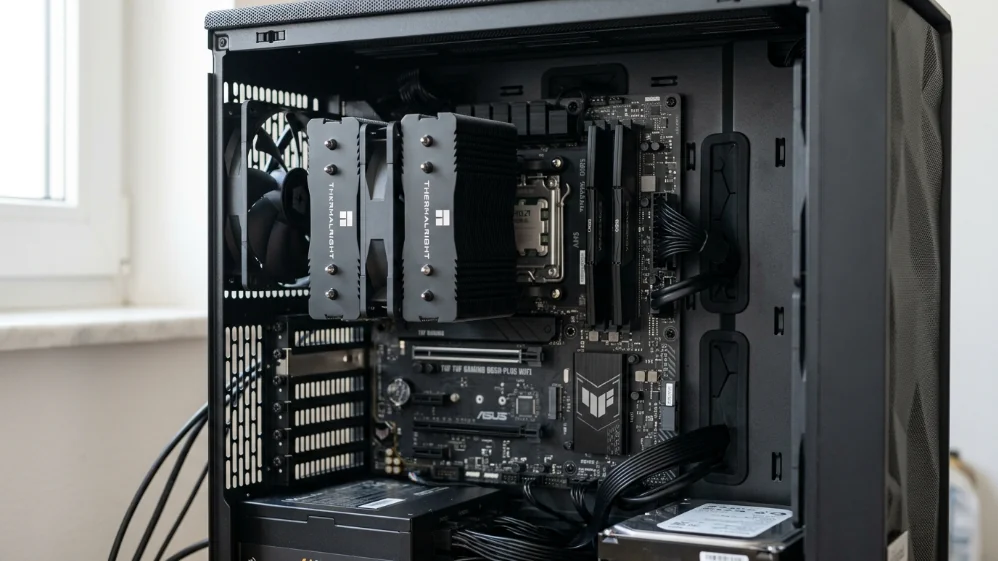
120W TDP, and it genuinely runs at that figure; unlike some Intel chips where the TDP is more of a suggestion than a limit, a Peerless Assassin 120 SE-class air cooler handles it without drama. A 240mm AIO is comfortable overkill for gaming loads, you don’t need a 360mm AIO or a premium X870E board to get the most out of this chip.
One important note for anyone upgrading into an older AM5 board: AGESA firmware version 1.2.0.2 or later is required for stable CPU scheduling, most boards released after November 2024 have this already, If you’re dropping the 9800X3D into an older B650 or X670 board, flash the BIOS with the current 7000-series chip first, then swap.
Productivity: No longer the weak spot
Previous X3D chips made you choose between gaming performance and productivity, the 9800X3D largely closes that gap, the cache-under-die design and higher Zen 5 IPC improvements allow it to match or exceed comparable 8-core Ryzen 9000 non-X3D chips in several productivity workloads.
It won’t compete with the Ryzen 9 9950X or 9950X3D in heavily multi-threaded work, 8 cores have limits, But for content creators or streamers who also game, the 9800X3D no longer requires a meaningful productivity sacrifice to get the best gaming performance available.
Where everything stands in 2026
AMD has no real competition in gaming CPUs right now, Intel confirmed Arrow Lake Refresh and Nova Lake for 2026, and AMD is teasing Zen 6 in the data center with a consumer release expected later this year, until those land, the X3D lineup owns the gaming CPU market.
Within the AMD lineup right now:
| CPU | Price (May 2026) | Gaming Performance |
|---|---|---|
| Ryzen 7 7800X3D | ~$324–360 | Excellent — ~7-8% behind 9800X3D |
| Ryzen 7 9800X3D | ~$438–440 | Best mainstream gaming CPU |
| Ryzen 7 9850X3D | ~$500 | 3.3% faster than 9800X3D, not worth the premium |
| Ryzen 9 9950X3D | ~$670 | Fastest gaming CPU overall, significant premium |
For most gamers, the 9800X3D is the sweet spot, The 7800X3D is the budget-smart alternative, the 9850X3D is hard to justify, the 9950X3D is for people who need both maximum gaming and maximum productivity performance and don’t mind paying $230 more for it.
Is it still worth buying in 2026?
Yes, with one honest caveat.
If you’re building fresh on AM5 today and gaming performance matters to you, the 9800X3D is the right chip, it’s the best gaming CPU at its price point by a comfortable margin, it runs cool and efficient, it overclocks well, and the AM5 platform is supported through at least 2027, the $438– 440 price is lower than its $479 launch and represents genuine value for what it delivers.
The caveat: Zen 6 is coming. If AMD hits a 2026 consumer release for Zen 6 and the new X3D variant is substantially faster than the 9800X3D, buyers in late 2026 will have a harder decision. Nobody knows exact timelines yet, and “expected later this year” in the processor world often means early next year. If you need a CPU now, the 9800X3D is the right answer. If you can wait six months comfortably, it might be worth keeping an eye on AMD’s announcements first.
Performance data sourced from Tom’s Hardware Ryzen 7 9800X3D review (November 2024), Tom’s Hardware CPU hierarchy (April 2026), Tom’s Hardware Best Gaming CPUs guide (May 2026), Tom’s Hardware Ryzen 7 9850X3D review (January 2026), Hardware Unboxed, TechSpot, and PCBuildHelper 7800X3D vs 9800X3D comparison (May 2026). Pricing from CamelCamelCamel (April 2026), Amazon US, Newegg, OnMSFT, and Wccftech (May 2026).
Pingback: Best RX 9070 XT PC Build for 1440p (2026) - Fragtrix
Pingback: Best 4K Gaming PC Builds Guide for 2026 - Fragtrix
Pingback: Best Gaming CPUs 2026: AMD and Intel Compared - Fragtrix
Pingback: CyberPowerPC vs Custom Build in 2026 - Fragtrix