
The RX 9070 XT launched at $599 MSRP in March 2025 and immediately made NVIDIA uncomfortable, fourteen months later it’s trading blows with cards that cost significantly more, the drivers have gotten meaningfully better since launch, and the 16GB GDDR6 VRAM advantage over the RTX 5070 keeps looking smarter as game texture budgets climb.
The catch in May 2026: street prices sit at $709–720, well above MSRP, that changes the math on “maximum value” but doesn’t change the card’s position, at 1440p rasterization, nothing at this price bracket touches it. Here’s how to put together this rx 9070 xt pc build properly.
The RX 9070 XT PC build
| Component | Pick | Price (May 2026) |
|---|---|---|
| GPU | RX 9070 XT (ASRock Challenger / XFX Quicksilver) | ~$709–720 |
| CPU | AMD Ryzen 5 9600X | ~$200–214 |
| Motherboard | MSI B650M Gaming Plus WiFi | ~$110–130 |
| RAM | 32GB DDR5-6000 CL30 (2x16GB) | ~$285–450 |
| Storage | 1TB NVMe PCIe Gen4 | ~$65–75 |
| CPU Cooler | ID-Cooling FROZN A410 | ~$35–40 |
| PSU | 750W 80+ Gold (850W recommended) | ~$80–100 |
| Case | Mid-tower mATX | ~$65–80 |
| Total | ~$1,549–1,809 |
The GPU price is the main variable here. The ASRock Challenger and XFX Quicksilver are currently the most accessible entry points at $709–720, set price alerts, the trend is downward from the $975 peak in May 2025, and deals appear regularly.
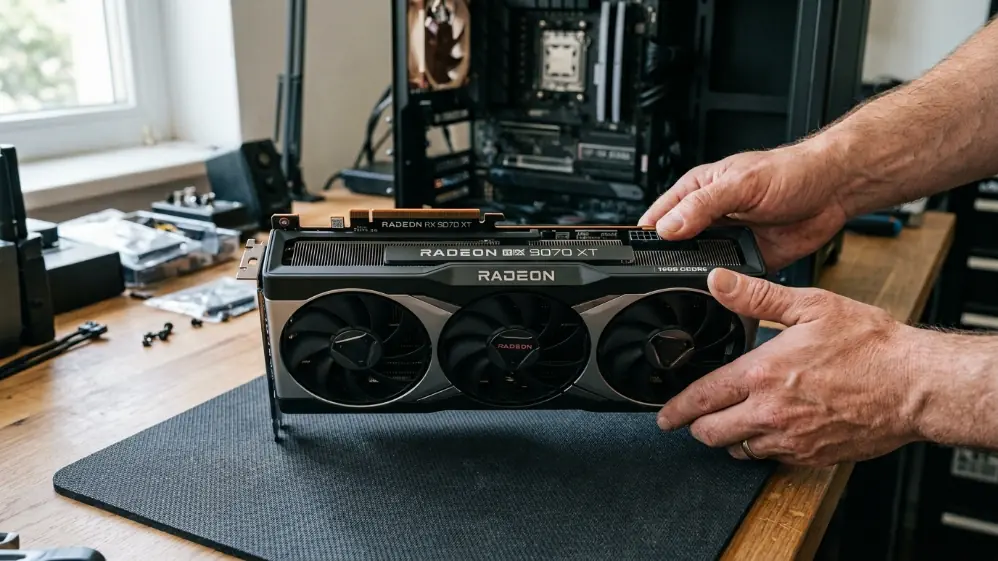
GPU: RX 9070 XT 16GB GDDR6
Why this card at 1440p
At 1440p rasterization, the 9070 XT runs within 3.5% of the RTX 5070 Ti, which costs significantly more, GamersNexus put both cards through their full test suite and that was the gap, 16GB GDDR6 on a 256-bit bus, RDNA 4 architecture, 64 compute units. The card is built for this resolution and it shows.
Against the RTX 5070, the more natural price comparison, the 9070 XT holds a 27% rasterization advantage at 1440p (GamersNexus), that’s a real gap. When you factor in the 16GB vs 12GB VRAM difference, the AMD card is the stronger 1440p choice on pure gaming performance grounds.
Drivers keep getting better
The launch day benchmarks from March 2025 already look dated, back in July 2025, Hardware Unboxed ran current Adrenalin drivers against the review press drivers and found a 9% raster performance gain at 1440p on average, counter-Strike 2 picked up 23%, Spider-Man Remastered 27%, Hogwarts Legacy 18%. By the time those driver gains landed, the 9070 XT had moved ahead of the 5070 Ti in 1440p rasterization.
The honest limitations
Ray tracing is where the 9070 XT concedes ground, gamersNexus put it directly: AMD gets crushed in tests like Black Myth: Wukong with RT enabled, the card is now competitive in mixed-load ray tracing, games using RT alongside rasterization, but in heavily path-traced workloads, NVIDIA’s architecture wins by a significant margin.
FSR Redstone launched in December 2025 with 200+ compatible games, FSR 4’s AI upscaling is genuinely excellent, Tom’s Guide described it as a resolution scaler that eliminates practically all ghosting, frame generation is the weaker point. When Tweaktown tested FSR Frame Generation ML in January 2026, it wasn’t quite as smooth or responsive as DLSS 4 Frame Generation, five months later it’s better, but DLSS 4 still leads in that specific department.
For 4K gaming with heavy RT, this isn’t your card. For 1440p rasterization at maximum value, it’s the best option at this price tier.
CPU: AMD Ryzen 5 9600X
Why the 9600X and not the 9700X
Pairing an RX 9070 XT with a Ryzen 7 9800X3D would be the peak gaming setup, but it would also push this build past $1,800 and defeat the “maximum value” premise, The Ryzen 5 9600X is the correct call here.
The 9600X (6 cores, 12 threads, 65W TDP) doesn’t bottleneck the 9070 XT at 1440p. At this resolution the GPU is always the limiting factor , the CPU sends data faster than the card can render it. You don’t need an 8-core chip to max out a 9070 XT at 1440p; you need the budget to go elsewhere.
At 1080p in CPU-bound titles, a Ryzen 7 9700X or 9800X3D would pull ahead, but this is a 1440p build. The 9600X earns its place.
The AM5 argument
AM5 is the same story as always, you’re buying the platform, not just the CPU. The 9800X3D already works on B650 with a BIOS update. Whatever comes after it will likely too. The 9600X gets you in the door at a price that makes sense now, and you can swap the CPU later without touching the rest of the build.
Motherboard: MSI B650M gaming plus wiFi
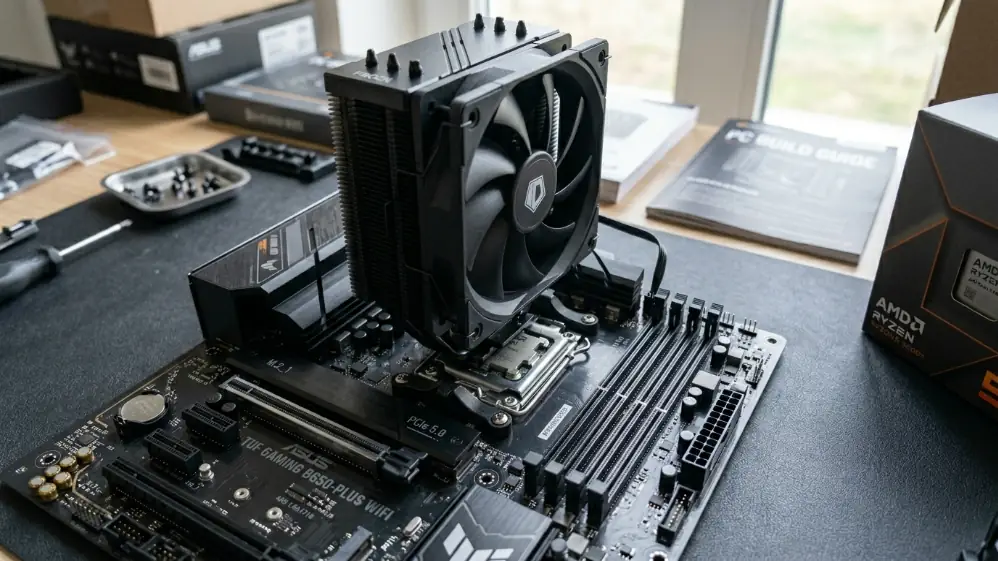
The MSI B650M Gaming Plus WiFi does exactly what it needs to at $110–130, AM5 socket, DDR5 with EXPO support, PCIe 5.0 M.2, WiFi 6E, 2.5G LAN, nothing missing, nothing unnecessary, the 9070 XT slots into the PCIe 5.0 x16 lane, though practically speaking PCIe 4.0 bandwidth is already more than any current GPU needs.
Spending $200 on a motherboard doesn’t move frames, B650 is the right chipset for a value build and this board is the right B650.
RAM: 32GB DDR5-6000
Same situation as any AM5 build in 2026, except worse: DDR5 prices spiked hard in early 2026, A 32GB DDR5-6000 CL30 kit that cost around $95 in early 2025 now runs anywhere from $285 to $450+ depending on brand, driven by AI-related DRAM demand and supply constraints. It’s painful, but it’s the reality.
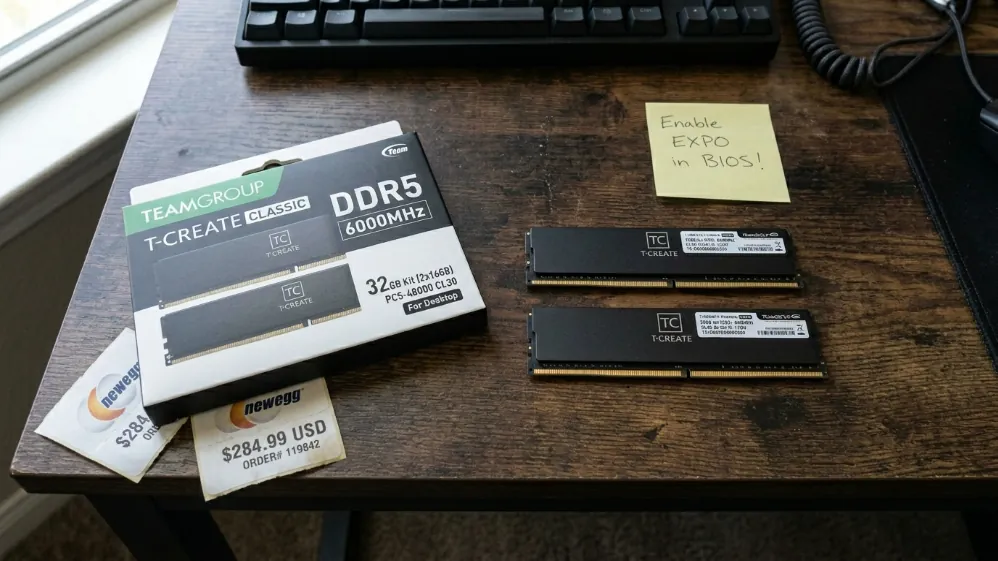
DDR5-6000 CL30 remains the sweet spot for Ryzen performance, enable EXPO in BIOS after installing or you’ll run at JEDEC defaults and leave frames on the table.
Don’t drop to 16GB to offset the RAM cost, at 1440p with Discord and a browser in the background, 16GB gets tight, the cheapest confirmed option right now is the Team T-Create Classic DDR5-6000 at $284.99, Tom’s Hardware’s RAM price tracker flagged it as the lowest available. Name brands like Corsair Vengeance run $439.99 and up. Check Newegg and Amazon daily, prices fluctuate fast and stock disappears quickly.
PSU: 750W minimum, 850W preferred
The 9070 XT’s 304W TDP is the key difference between this build and the RTX 5070 equivalent, in GamersNexus’s testing, the card pulled 310W during Starfield at 1440p, so custom OC models from board partners can and do run higher.
Corsair’s official recommendation is 750W for this GPU. With the Ryzen 5 9600X at 65W TDP, total system draw sits around 420–450W typical gaming load, well within a 750W unit’s operating range. That said, 850W gives meaningful transient headroom and is worth the extra $15–20 if you’re building to last, stick to established PSU brands: Corsair, Seasonic, be-quiet!, EVGA if you can find them.
Storage: 1TB NVMe PCIe Gen4
1TB is listed here to keep the build total honest, modern AAA games are large, and if you have a library of four or five major titles installed simultaneously, 1TB fills up. Upgrading to 2TB adds roughly $25–35 to the total. Both configurations work, decide based on your library habits.
PCIe Gen4 is the right tier for this build. Gen5 drives cost more and don’t meaningfully improve gaming load times, WD Black SN850X or Samsung 990 Pro are the safe picks.
What this build delivers
What the numbers look like
| Resolution | Scenario | Expected Performance |
|---|---|---|
| 1080p | Native, max settings | 200+ FPS in most titles |
| 1440p | Native, high/ultra | 90–130 FPS in demanding AAA |
| 1440p | FSR 4 Quality mode | 130–180+ FPS in supported titles |
| 1440p | RT mixed workloads | 60–90 FPS depending on game |
| 4K | Native, ultra | 55–75 FPS in rasterized titles |
| 4K | FSR 4 Quality | 80–110 FPS in supported titles |
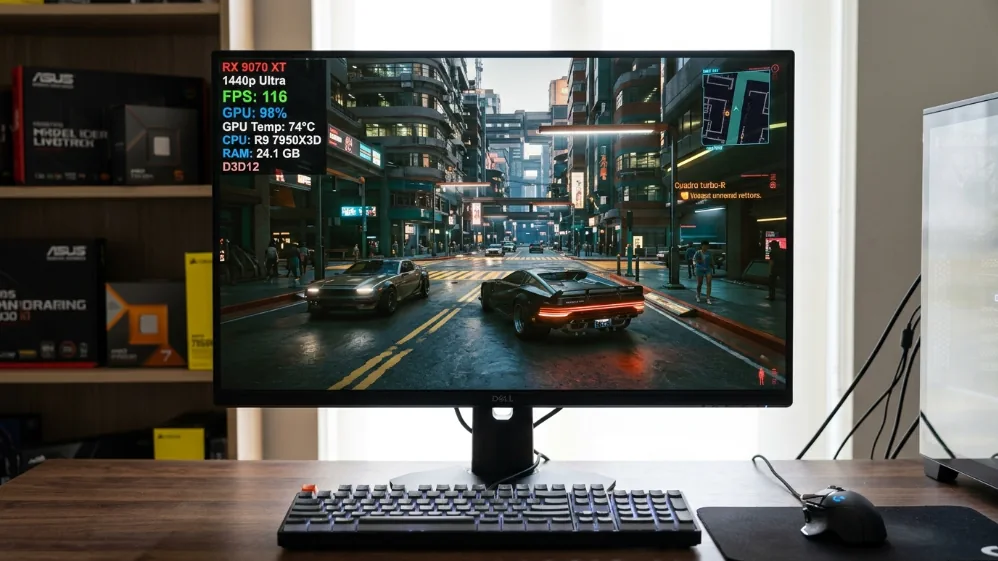
Tom’s Hardware put the 9070 XT at the top of their 4K value list in their 2026 GPU hierarchy, 60 FPS average across their full rasterization test suite, the card was built for 1440p, but 4K without upscaling is workable in most titles, with FSR 4 Quality mode, it runs cleanly at 4K in everything that matters.
RX 9070 XT vs RTX 5070: Why AMD Here
This build exists because the RX 9070 XT wins the 1440p value argument over the RTX 5070, More VRAM (16GB vs 12GB), faster native rasterization (+27% per GamersNexus), and with a year of driver updates behind it, real-world performance that matches or beats the RTX 5070 in most titles, the RTX 5070 hits back with better ray tracing, DLSS 4 ecosystem, and lower power draw, for a build focused on maximum 1440p rasterization value, AMD is the right call.
Is this build worth it at $709–720 for the GPU?
It’s less clean than it was at $599 MSRP, that’s just the honest truth, at $709 you’re paying an 18% premium over launch for a card that was already aggressively priced. But the RTX 5070 is also above MSRP, and the 5070 Ti sits significantly higher, within its actual competitive set, $709 for the 9070 XT still makes sense.
RAM pricing in 2026 didn’t help either, the cheapest verified 32GB DDR5-6000 kit sits at $284.99 right now versus around $95 in early 2025, that delta hits every AM5 build equally.
Watch for deals. The price has been declining from its $975 peak, the ASRock Challenger and XFX Quicksilver variants are the most accessible entry points right now, check Newegg and Amazon regularly, and don’t pay above $720 without a free game bundle or other tangible addition.
Performance data from GamersNexus RX 9070 XT review (March 2025), Hardware Unboxed driver performance update (July 2025, via TechPowerUp), TechSpot RX 9070 XT review (March 2025), Tom’s Hardware GPU hierarchy (May 2026), Tom’s Guide RX 9070 XT review, and Tweaktown ASRock RX 9070 XT review (January 2026). Pricing from Amazon US, Newegg, BestValueGPU, gpudeals.net, and PCGuide, May 2026.
Pingback: Best 4K Gaming PC Builds Guide for 2026 - Fragtrix